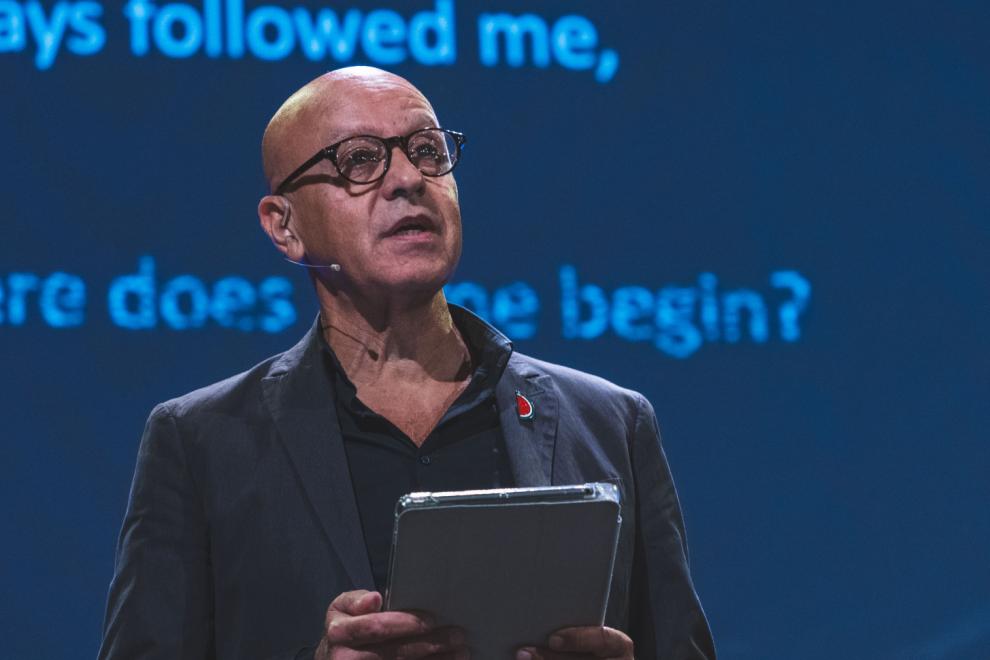
Full text of the keynote speech of the European Jazz Conference 2025 delivered by Nabil Bey Salameh, published with the permission of the author.
Home in the In-Between
I. A Name to Give to Silence
There’s a question that has always followed me, like an echo:
Where does exile end, and where does home begin?
Somewhere called home—the title chosen for this gathering—suggests this:
An undefined place, a dreamt-of place.
A place that is not yet, but could be.
A place that, at times, is made more of sounds than of stones.
More of voices than of borders.
I come from a land that today does not exist on the maps of power: Palestine.
I was born in Lebanon, a country that welcomed my family after they were forced to leave their home.
A home that was more than a house.
It was a convivial, secular, vibrant society, shattered by a colonial project that still today produces destruction, apartheid, genocide and complicit silences.
I grew up in a border zone, near refugee camps, among sirens, curfews, and songs.
But I am not here to tell you about pain—I am here to tell you about a sonic resistance.
A possibility.
Bari has become one of my homes.
Not the kind made of bricks,
but the kind made of welcome, connections, reverberation.
In this city, a port and a bridge, I have found fragments of Beirut and Jaffa.
I have felt the light of Palestine inside the light of Puglia.
And I have understood that home can also be a movement:
a constant navigation between what we have lost and what we can still build together.
II. Jazz as a Sonic Passport
Jazz has never been afraid of borders.
It is a mixed, free, disobedient music.
It was born as a cry of freedom in the neighborhoods of oppression.
And it has traveled, transformed, and conversed with Africa, with India, with Europe, with the Mediterranean.
Jazz is the art of risk and listening.
An art that teaches us that you don’t play music alone.
That dissonance can become harmony.
That mistakes are just another path.
I think of Max Roach, who in 1960 said:
"Music is my way of saying that I am a man."
He showed us that rhythm itself can become a march toward freedom.
I think of Nina Simone, who reminded us that music is also a political cry, an act of dignity;
I think of the Liberation Music Orchestra and Charlie Haden, who turned the double bass into a voice of solidarity with oppressed peoples;
And I think of John Coltrane, who elevated lament into a collective prayer, capable of uniting memory and hope.
Like my own personal story, jazz doesn’t ask permission to exist.
But takes its place anyway, among the notes, and tells its tale.
It tells what the official history books have omitted.
It tells of displacement, sleepless nights, silenced voices.
And even today, here, it can become a bridge between the two shores of the Mediterranean:
Between those who come and those who stay.
Between those who have lost everything and those who still fear losing something.
Between those without a voice and those who can lend their own.
III. Living in the Middle
Home in the In-Between.
A home in between.
A home between two cultures, two languages, two silences.
I am neither on one side nor the other.
I am a bridge—sometimes fragile, but alive.
I try every day not to give in to nostalgia for a firm belonging.
To inhabit a work-in-progress as if it were home.
Being a migrant doesn’t just mean moving from place to place.
It means trying every day to redefine the meaning of the world.
It means recognising glimpses of home in the gestures of others.
In new words, in familiar flavors that resurface.
In a sound that crosses the boundaries of the soul.
Migration is not a problem.
It is a collective opportunity.
A source of thought, of energy, of poetry.
In our cities live men and women who carry with them
not only traumas, but languages, rhythms and knowledge.
And culture—above all, music —can become the place where these stories live on.
Where roots are planted without putting up barriers.
Where other people are a new experience, not a threat.
In this European society that so often takes refuge in its own selfishness,
art can be the antidote to every sterile nationalism.
An invitation to listen instead of control.
An open approach instead of a closed identity.
IV. Somewhere We Can Call Home
We are not here just to celebrate a type of music.
We are here to affirm a vision of the world.
A vision where culture is not entertainment, but a cure.
Where art is not only beauty, but reconstruction.
Where jazz is not just a genre, but an ethical gesture.
In times like these—marked by unpunished genocides, by wars and injustice,
by walls disguised as humanitarian actions—
we, artists, organisers, listeners,
have the duty not to remain silent.
And not to allow ourselves to be numb.
V. The Power of Music
Today, as we talk of home, of welcome, of building bridges,
we cannot ignore the tragedy unfolding before the eyes of the world.
In Gaza, for almost two years, the civilian population has been living a daily nightmare
of bombings, hunger, systematic destruction.
There is no other word to describe it but Genocide.
And staying silent means being complicit.
The power of music is not to stop wars.
No song can ever replace a peace treaty.
Yet music has a rare gift: it can stop time, even if only for an instant.
In that instant, a different space is born—
a space for reflection and understanding,
for empathy and awareness.
Music reminds us of our vulnerability,
but also of our capacity to feel like a community,
to recognise in the other a face, a voice, a story.
Its beauty becomes humanity.
And true humanity leads above all to justice.
Because without justice there is no peace:
there is only surrender to the law of the strongest.
Music neither wins nor loses: it unites.
It creates bridges, tears down invisible walls,
teaches respect and sensitivity.
This is the profound meaning of our gathering in Bari:
to use music not to distract ourselves,
but to awaken consciousness,
to make us more alert, more human,
and therefore more free.
VI. Conclusion
In this sea that both divides and unites,
music can still show us that the other is possible.
That not everything is lost.
That every sound can become a haven.
I will continue, in my own small way,
to act as a bridge between the past and what the future can still be.
Between a Palestine that resists and a Puglia that welcomes.
Between the language of memory and that of invention.
And if somewhere there is a home we can truly call our own,
Maybe it will be the one we build together.
With each note and each act of listening,
without borders, without frontiers,
but with deep roots and open arms.
Thank you.
Thank you to those who listen, who welcome,
who make meeting possible.
Nabil Bey Salameh
(Bari, 26 September 2025)
DOWNLOAD THE ORIGINAL VERSION IN ITALIAN (pdf).
DOWNLOAD THE ENGLISH VERSION (pdf).
—
About Nabil Bey Salameh
A multifaceted Italian-Palestinian artist. Born in Tripoli, Lebanon, he moved to Italy to complete his university studies in engineering. He was a forerunner of the first world music experiences in Italy with the group Al Darawish. He later founded Radiodervish, one of the most established world music ensembles in Italy, with which he still carries out an intense concert and recording activity.
For years he was a correspondent in Italy for Al Jazeera, and he is currently Professor of Ethnomusicology at the Tito Schipa Conservatory of Lecce. His artistic research has long extended beyond music, embracing literature, theater, and poetry.
He has collaborated with many prestigious artists, including Franco Battiato, Massimo Zamboni, Stewart Copeland, Paola Turci, Niccolò Fabi, Simone Cristicchi, Yo Yo Mundi, Giuseppe Battiston, Carlo Lucarelli, among many others. Author of several essays on Arab music and numerous translations from Arabic, he has been a speaker at numerous conferences on Arab culture and music.
Current Projects:
- Ghibli – a project that blends Mediterranean soundscapes with Palestinian musical traditions, preserving cultural memory and resilience through music.
- Radiodervish – a renowned ensemble of world music and Mediterranean songwriting, active with international tours and major recording productions.