European Jazz Conference
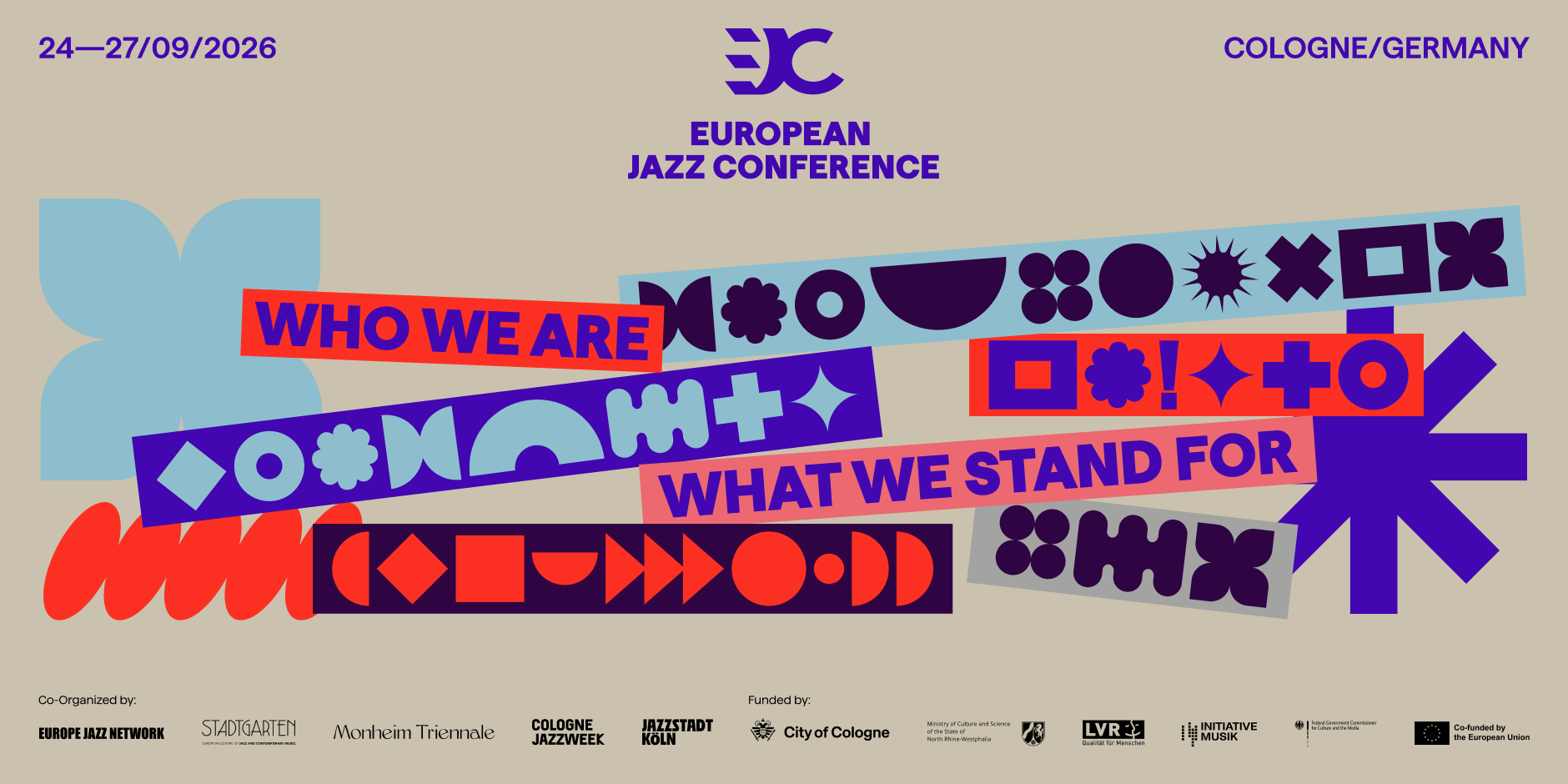
The 12th European Jazz Conference brought the Europe Jazz Network (EJN) and the wider creative music community together in Cologne from 24 to 27 September 2026. Under the theme “Who We Are, What We Stand For”, four days of discussion, music and exchange explored shared values and responsibilities, strengthened international connections and celebrated outstanding work across the sector.
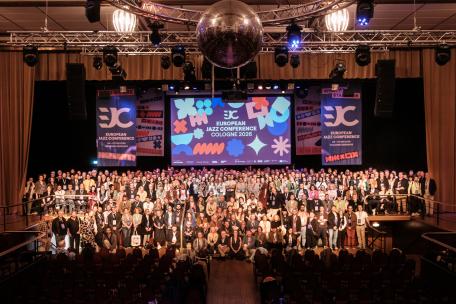
Co-organised by EJN, Stadtgarten Köln, Cologne Jazzweek and Monheim Triennale, the European Jazz Conference took place in Germany for the first time. It welcomed 440 delegates from 38 countries to discuss the future of jazz and contemporary improvised music and the role of the organisations and people who support it.
Shared Values and International Collaboration
At the heart of this year’s conference was a discussion about what the European jazz community stands for and how its values can guide its work. Through talks, discussions and encounters, participants explored social responsibility, international cooperation and the conditions in which jazz and improvised music are created, shared and presented today.
As EJN’s annual gathering, the conference provided a space for members and colleagues from across Europe and beyond to exchange experiences, learn from one another and develop new collaborations. It also brought different generations of music professionals together to reflect on the sector’s achievements and consider its future direction.
A Platform for Germany’s Creative Music Scene
The public showcase programme introduced international delegates and local audiences to the diversity of Germany’s contemporary jazz scene. Thirteen selected groups, comprising 50 musicians based in Germany, performed at venues across Cologne, including Stadtgarten, Sartory-Saal and LOFT.
The programme connected artists with music professionals from across EJN and the wider international community, creating opportunities for discovery and future collaboration. WDR 3, the conference’s media partner, will broadcast many of the showcases as part of a nationwide ARD Jazz Night in spring 2027.
Following Stadtgarten’s 40th anniversary celebrations and Cologne Jazzweek, the conference also highlighted the city’s longstanding contribution to European jazz. Its venues and local music community offered a welcoming setting for international exchange and an opportunity to experience different approaches to presenting contemporary music.
EJN Awards Recognising Outstanding Work
The conference celebrated organisations and artists whose work reflects the creativity, commitment and social engagement of the wider jazz community.
The EJN Award for Adventurous Programming went to Südtirol Jazzfestival Alto Adige, recognising its distinctive artistic vision and commitment to bold programming.
The EJN Award for Music & Community was presented to Victory Beats, the Ukrainian initiative that develops music programmes for people injured in the war and for veterans, highlighting music’s role in supporting people and communities.
The conference also celebrated Hyphen Dash from Kyiv, winners of the inaugural Ukrainian Jazz Prize, presented in partnership with the Ukrainian Institute. The four-piece ensemble performed live, bringing their music to an international audience of colleagues and programmers.
Building Connections Across Europe and Beyond
The 12th European Jazz Conference reaffirmed EJN’s role in bringing the creative music sector together, supporting the exchange of ideas and experiences, and creating opportunities for cooperation across borders. The discussions and performances in Cologne highlighted both the diversity of the European jazz community and the shared commitment that connects its members.
These conversations and connections will continue through EJN’s activities and at the next European Jazz Conference. The 13th edition will take place in Alghero, Sardinia, from 30 September to 03 October 2027.
12th European Jazz Conference
24 - 27 September 2026, Cologne, Germany
Who We Are, What We Stand For
Whenever we meet these days, we share stories of our professional struggles: struggles to make ends meet, cope with soaring costs, stay afloat as cultural priorities shift, keep staff motivated, retain audiences and remain optimistic in the face of it all.
The new reality is that our sector is in crisis: the geopolitical climate is worsening each day, with governments in the US and parts of Europe using culture as a tool to drive nationalistic, divisive agendas and to retain power. At the same time, organisations are losing funding, staff and audiences, bringing an increased risk of drained energy and motivation.
In such times, we need strategies to secure our economic and artistic survival, effective tools to influence policymakers and to anchor our role within cultural agendas, and guidance on how to cope with mounting pressures and to renew our sense of purpose. We must strengthen our collective voice as upholders of democratic values and position jazz and improvised music as vital spaces for civic engagement and cultural enrichment. Our duty is not merely to find ways to survive, but to be instrumental in advancing social and democratic prosperity in our societies.
Our actions must reflect what defines us. By reclaiming our sense of mission in a world facing ethical challenges, and by taking strength in numbers, we can continue to assert the value and power of culture. We must recognise what is at stake: hold on to our vision and commit to our role in shaping a more open, democratic and culturally vibrant society. In essence: who we are and what we stand for.
Thursday, 24 September 2026
- FOR EJN MEMBERS ONLY -
14:00 - 20:30 Registrations for EJN members - Volksbühne
15:00 - 15:50 Welcome session for new members and ‘30 under 35’ - Volksbühne
16:00 - 17:30 Brainstorm on EJN strategy & future activities (split groups) - Volksbühne
17:30 - 17:45 Coffee break
18:00 - 20:30 FORMAL EJN GENERAL ASSEMBLY - Volksbühne
- OPEN TO ALL -
20:30 - 21:30 SHOWCASE: Florian Herzog’s Almost Natural - LOFT
22:30 - 23:00 SHOWCASE: Sera Kalo’s eX.II - Stadtgarten Concert Hall
23:20 - 23:50 SHOWCASE: MALSTROM - JAKI, Club at Stadtgarten
Friday, 25 September 2026
09:30 - 19:00 Registrations for everybody - 25hours Hotel
10:30 - 11:00 Official opening and welcome speeches - Sartory Hall
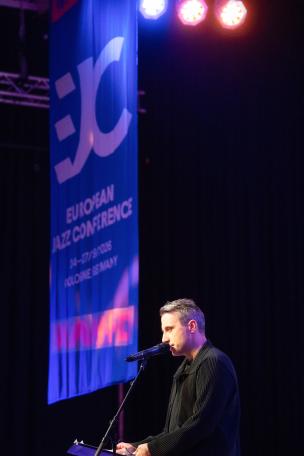
11:00 - 11:20 KEYNOTE SPEECH: Alexander Hawkins (UK) “The authoritarian’s trap, and the virtue of invisibility” - Sartory Hall
Many people can identify with the desire to stand for something - perhaps especially in times such as our own in which the geopolitical climate is so precarious. But feeling the desire to stand for something is very different from articulating what that thing might be: and in any case, who do we think our audience is? Do they even care what we stand for? Taking a stand might appease our collective conscience (whatever value that idea may or may not have), but if we are to achieve anything other than rearranging the deck chairs on the Titanic, we need to beware of a particular type of political misdirection. Can we avoid this misdirection, and still find relevance in the world in which we find ourselves?
11:30 - 12:30 PLENARY PANEL DEBATE: Who We Are, What We Stand For - Sartory Hall
Building on the ideas raised in Alexander Hawkins' keynote, this panel brings together artists, programmers and policymakers to discuss this year's conference theme: Who We Are, What We Stand For. Together, they will reflect on what it means to create, present and support jazz and improvised music at a time when artistic freedom, cultural values, public funding and democratic principles can no longer be taken for granted.
- Isabel Pfeiffer-Poensgen (DE), former State Minister for Culture for North Rhine-Westphalia
- Eric Birath (SE), director of Fasching club & Stockholm Jazz Festival
- Shabnam Parvaresh (IR/DE), artist & artistic director of Morgenland festival
- Daniel Zimmermann (DE), former Mayor of Monheim
- Moderator: Virgo Sillamaa (EE), European Music Exporters Exchange
12:30 - 13:00 Group photo - Sartory Hall
13:00 - 14:30 Lunch - 25hours Hotel
15:00 - 16:30 Five parallel DISCUSSION GROUPS:
#1 - Resourcing our activities in an increasingly uncertain political & economic environment - for large festivals & venues (over 10 FTE staff / annual turnover above €1 million) - Ostermann hall / Sartory
How can larger festivals and venues maintain financial stability while staying true to their artistic vision and public mission? As political and economic uncertainty grows, this peer-learning session invites participants to exchange experiences, challenges and good practices around funding, audience development, programming independence and new income models. Together, participants will explore practical strategies for sustaining large organisations while defending culture and safeguarding the values that underpin our music.
- Chair: Ros Rigby (EJN Honorary member, UK)
#2 - Resourcing our activities in an increasingly uncertain political & economic environment - for small clubs & festivals (under 10 FTE staff / annual turnover below €1 million) - Large meeting room / 25hours
How can grassroots venues and festivals remain resilient in an increasingly uncertain environment? This peer-learning session will explore how small clubs and festivals sustain their work through strong community connections, diverse income streams and collaborative approaches. Participants will exchange experiences and successful examples around alternative funding models, audience engagement and local partnerships, while reflecting on how to maintain cultural relevance and artistic independence in politically and economically challenging contexts.
- Chair: Eric Birath (Fasching & Stockholm Jazz Festival, SE)
- Daniel Radtke (Pardon, To Tu, PL)
- Çağıl Özdemir (Bozcaada Jazz Festival, TR)
#3 - Resourcing our activities in an increasingly uncertain political & economic environment - for National / Regional Support Organisations - Small meeting room / 25hours
National and regional support organisations play a unique role in strengthening the jazz and improvised music sector through advocacy, networking, talent development and international collaboration. But how can they continue to fulfil this mission in the face of political and financial uncertainty? This highly participative session will explore how organisations can adapt to changing funding landscapes, respond to shifting expectations, and maintain their impact while staying true to their core purpose. Participants will exchange information about, and learning from, successful projects, and work in small groups to shape potential new ideas and collaborations.
- Chair: Julia Payne (The Hub, UK)
- Stefan Rusconi (Árvore Foundation, CH)
#4 - Who’s in the room? Embedding diversity through community-led practice & participation - Kajute room / Sartory
What does diversity and inclusion look like as a genuine working practice, and what steps do organisations need to take to get there? This session explores access and participation: creating real opportunities for people to engage with jazz regardless of background, age or origin, while challenging the idea that jazz belongs only to a selected elite. It also questions traditional outreach models, asking how organisations can move from pre-defining what communities need to listening, co-creation and shared authorship. The discussion will focus on three interconnected areas: audiences, musicians and teams. Participants are invited to bring their own experience to the table, contributing to an honest dialogue on how to move from good intentions to meaningful structural change.
- Chair: Tasha Slagtand (House of Knowledge, NL)
#5 - From radio to influencers: analysing the changing relationship between jazz & media professionals - Foyer bar / 25hours
The media landscape for jazz and improvised music is changing rapidly across Europe, with countries facing different realities. Yet one thing remains constant: artists and organisers need knowledgeable voices that can engage critically with their work, tell their stories, and connect them with new audiences. As funding for specialised media declines, how can these essential but fragile ecosystems be sustained? Can social media and influencers create new opportunities, or do they simply reinforce the homogenisation of tastes and habits? This session will explore alternative and sustainable models for collaboration between artists, organisers and both traditional and emerging media professionals.
- Chair: Aida Baghernejad (journalist and culture critic, DE)
- Ian Patterson (All About Jazz, UK)
- Fanny Opitz (freelance journalist, DE)
- Veronika Friedlová (EJN mentee, CZ)
- Enrico Bettinello (Circolo Controtempo, IT)
17:00 - 17:30 SHOWCASE: Olga Reznichenko Trio - Stadtgarten Concert Hall
17:40 - 18:10 SHOWCASE: CHEEL - JAKI, Club at Stadtgarten
18:10 - 19:00 Free time / networking
19:00 - 21:00 Dinner - 25hours Hotel
21:00 - 21:40 SHOWCASE: Zola Mennenöh’s A LABOUR OF LOVE - Sartory Hall
21:50 - 22:30 SHOWCASE: Holly Schlott’s Unique - Sartory Hall
Late night programme
23:00 - xyz w/ Futurę Sounds Of Jazz hosted by Uh-Young Kim, JAKI, Club at Stadtgarten
With the 16th edition of the compilation series “Future Sounds Of Jazz”, Michael Reinboth (Compost Records, Munich) and Michael Rütten (Soulpatrol, Frankfurt) present handpicked tracks from Disco Jazz, Spiritual House, Techno Soul, and tropical rhythms. Styles: Disco Jazz, Spiritual House, Techno Soul, Breakbeats
23:00 - Wind down / social gathering, Monkey bar / 25Hours hotel (top floor)
Saturday, 26 September 2026
09:30 - 15:00 Registrations for everybody - 25hours Hotel
10:30 - 11:00 Celebration of the EJN Awards 2026 - Sartory Hall
We will present and celebrate the winners of the three awards bestowed by EJN this year: the Award for Adventurous Programming, the Music & Community Award, and the new Ukrainian Jazz Prize, presented in collaboration with the Ukrainian Institute. The ceremony will be followed by a performance from the Grand Prix winner of the Ukrainian Jazz Prize, Hyphen Dash from Kyiv.
11:00 - 11:30 SHOWCASE: Hyphen Dash / Ukrainian Jazz Prize Winners 2026 - Sartory Hall
11:45 - 13:00 Five parallel DISCUSSION GROUPS:
#1 - Maintaining values & defending artistic freedom in music programming - Foyer bar / 25hours
Every programming decision reflects a set of values, whether explicit or implicit. But how do we uphold artistic freedom and democratic values while navigating changing social expectations, funding priorities and the realities of today's cultural landscape? Building on the discussions initiated in previous European Jazz Conferences, this session will bring together experienced and emerging programmers to reflect on how personal beliefs, artistic vision and institutional responsibilities shape programming choices, and to explore how we can continue to defend artistic freedom while staying true to the values that define our music.
- Chair: Mark van Schaick (Buma Cultuur/injazz, NL)
- Annika Sautter (Jazzclub Leipzig, DE)
- Stefano Zenni (Torino Jazz festival, IT)
- Marina Fernandez (Festival JazzCádiz, ES)
- Danny Theuvis (Leuven Jazz, BE)
#2 - Fair play: shaping a Fair Practice Charter for the creative music sector - Kajute room / Sartory
This working group is dedicated to collectively shaping a framework for fair practices in the jazz and improvised music sector by discussing and refining the draft Fair Practice Charter developed over the past months by the EJN task force led by Charles Gil. Topics for discussion include fair pay, working conditions, social security and professional recognition, mobility and cross-border equity, transparency and accountability, diversity and inclusion, climate responsibility, artistic freedom and participation in governance.
- Chair: Charles Gil (Vapaat äänet, FR/FI)
#3 - Scene development: cherishing artists, promoters, talent incubators & audiences - Ostermann hall / Sartory
How do local music scenes emerge, and what helps them grow? Often they begin when artists, promoters and communities come together to fill a gap in the cultural landscape. But how can small scenes gain greater visibility while retaining their identity and civic engagement? What role do audiences play, and how can larger institutions amplify the energy of grassroots initiatives without overshadowing them? This working group will discuss how scenes have developed in different contexts, from small towns to major cities, and discuss how artists, promoters and cultural organisations can nurture local ecosystems and help them create an impact far beyond their own communities.
- Chair: Esther Weickel (NICA Artists Development, DE)
- Marie Blobel (jazzexzess, DE)
- Angelos Kleitsikas (Athens Jazz, GR)
- Urs Benedikt Müller (LOFT, DE)
#4 - Wellbeing & mental health: setting good practice in our daily work - Small meeting room / 25hours
Working in the live music sector often means juggling tight deadlines, small teams, limited resources and an "always on" mentality. Looking after our wellbeing and mental health is therefore not just a personal responsibility, but a vital part of building resilient organisations and sustainable careers. In this interactive, solution-focused session, participants will reflect together on practical approaches to managing workload, time and capacity, exchange good practices, and reflect on how to foster workplace cultures where people feel supported, empowered to set healthy boundaries, and able to thrive, both individually and collectively.
- Chair: Rosana Corbacho (M.I. Therapy, ES)
#5 - Will digital tech reshape live music, creative processes and communities? - Large meeting room / 25hours
Digital technologies are expected to rapidly reshape the live music ecosystem, influencing artistic practice, creative collaboration and community building. This session will discuss whether the sector can embrace innovation while keeping artists and audiences at the centre. Through insights from two Horizon Europe-funded projects, AMPLIFY and PULSE, participants will discover new research, including the first findings from a Europe-wide survey exploring how artists are using, or choosing not to use, AI in their practice, and discuss the opportunities and challenges these developments present for the future of the live music sector.
- Chairs: Katrien De Moor (NTNU, BE/NO), Riku Roihankorpi (LIDIA live, FI), Ibrahim El Shemy (NTNU, IT/NO)
13:00 - 14:30 Lunch - 25hours Hotel
15:00 - 16:00 Two parallel SESSIONS:
#1 - Speed meetings for EJN members only - Stadtgarten Green Room
An informal, fast-paced networking session exclusively for EJN members. Through a series of five-minute one-to-one conversations, participants will have the opportunity to meet colleagues, both familiar faces and new connections, and exchange ideas, needs and opportunities. A simple and effective way to strengthen relationships, share experiences, and spark new collaborations across the network.
- Facilitator: Mark van Schaick (Buma Cultuur/inJazz, NL)
#2 - Free time / Networking
16:15 - 16:45 SHOWCASE: Rabih Lahoud's MASAA - Stadtgarten Concert Hall
16:45 - 17:15 Conference wrap-up & presentation of the European Jazz Conference 2027 - Stadtgarten Concert Hall
As the Conference comes to a close, this final session will reflect on the conversations, ideas and connections of the past three days, identifying the collective actions needed to strengthen our sector and uphold the values that unite us. We will also look ahead to the next European Jazz Conference, offering a first glimpse of the 2027 host city and inviting participants to continue shaping the future of our sector together.
17:30 - 18:00 SHOWCASE: Sheen Trio - JAKI, Club at Stadtgarten
18:15 - 18:45 SHOWCASE: NEON DILEMMA - Stadtgarten Concert Hall
19:00 - 21:00 Dinner - Stadtgarten beer garden
21:00 - 21:30 SHOWCASE: Evi Filippou’s InEvitable - Stadtgarten Concert Hall
21:45 - 22:15 SHOWCASE: GANNA - JAKI, Club at Stadtgarten
22:30 - 23:10 SHOWCASE: BIG BREEEZY´s MUMBLE MAFIA - Stadtgarten Concert Hall
Late night programme
23:30 - Tom-Tom Discotec presents: Analog Africa w/ Samy Ben Redjeb, EL FLAMBO, Asal & Hermes Villena, JAKI, Club at Stadtgarten
As the closing party of the EJC, Tom Tom Discotec welcomes Analog Africa – one of the leading labels for reissues of African and Latin American music. More than mere retro nostalgia, Analog Africa is a passionate act of musical archaeology, celebrating pioneering artists and the vibrant sounds they created under often challenging political circumstances. A journey through Afro-Funk & Afrobeat, Highlife, Cumbia & Psychedelic Chicha, Congolese Rumba & Soukous, Funaná & Morna.
Sunday, 27 September 2026
Cultural tours & activities, three parallel options:
11:00 - 13:00 FILM SCREENINGS - Filmpalette Cinema, Lübecker Straße 15, Köln
-
DREAM BABY DREAM (start: 11:00) - Filmed during Jazzfest Berlin 2025, the experimental short film brings together 60 Berlin-based participants to explore central questions of our time through music, movement and poetry in a collaboratively created work. The film was developed over four months in autumn 2025 by a 10-member creative team of Berlin-based artists, musicians, choreographers and international filmmakers; (2026, approx. 20 minutes).
- EVERY NOTE YOU PLAY (start: 11:30) - Every Note You Play is Finnish director Mika Kaurismäki’s cinematic documentary on the Monheim Triennale. Capturing the unique encounters of sixteen world-class musicians during The Prequel 2024, the very intensely realized film offers a look behind the scenes and reveals how “musical boundaries were crossed, energy was released, and the deepest essence of creativity came to the fore” (Kulttuuritoimitus, Finland); (2025, approx. 80 min.)
11:00 - 12:30 WALKING TOUR #1: A new hope, a new beginning - Connecting the dots of Cologne's music and art scene - meeting point at Stadtgarten
Cologne has a long-standing modern music tradition, ranging from jazz, rock, electronic and classical music, that began in the wake of its ultimate watershed: the end of Nazi Germany and the horrors of the Second World War. In the vastness of debris and destruction new forms of music and art were attempted to be formed and created, in alignment with a new society. Within this process Cologne emerged to become one of the central hubs for art and music in central Europe. On this walking tour through Cologne’s city-center we want to connect the dots out of landmarks, places and references that tell the (hi)story’s of Cologne's modern music and art scenes and see how these mingle and intertwine with historic developments.
11:00 - 12:30 WALKING TOUR #2: Stories of the city and the typical Cologne way of life - meeting point at 25Hours Hotel
Beyond all significant cultural highlights, every city, of course, has its own subtle vibe. Without standing out, it drapes like a silent beat over everything that happens. When you feel this momentum, you are no longer just a spectator but immerse yourself in the feeling of the city and take deep pleasure in letting yourself be carried away. As a special kind of city tour, "Cologne is a Feeling" shows you in a highly humorous way what genuinely makes Cologne, Cologne - what is typically Cologne. Is it the infamous Kölsche Klüngel? Or perhaps the strangely charming city characters like "Tünnes and Schäl" or the Kallendresser? Maybe the secret of Cologne lies in its zest for life, in the singing culture that emanates from many pubs, not only during carnival. Or in the numerous stories told about its inhabitants, personalities, and their optimistic life philosophies. You will find out...
Alexander Hawkins
Keynote speech on Friday, 25 September. 11:00-11:20, Sartory Hall.
Alexander Hawkins is a British composer, pianist, organist, and bandleader who is ‘unlike anything else in modern creative music’. Regarded as one of his generation’s most innovative thinkers, his own unique soundworld is shaped by a profound fascination with composition and structure, alongside a love of chance and open forms.
He is a frequent solo performer, and also appears in groupings ranging from duo (with the likes of Nicole Mitchell, Sofia Jernberg, Tomeka Reid, Hamid Drake and others), through to large ensembles. His Ensemble music, at the core of which often sits his long-standing trio, was said by The Guardian newspaper to sound ‘like all the future jazz you might imagine without ever being able to conceive of the details.’
Hawkins work as a bandleader has been released for the past decade by Intakt Records. He enjoyed a near-15 year association with the legendary South African drummer, Louis Moholo-Moholo, and for a similar period of time has toured the world with Ethio-jazz pioneer Mulatu Astatke. He has been widely commissioned, by the likes of the BBC, festivals such as the London, Cheltenham, and Berlin Jazz Festivals, venues such as the Pierre Boulez Saal, and contemporary music groups such as the Riot Ensemble. He was named ‘Instrumentalist of the Year’ in the 2016 Parliamentary Jazz Awards and 'Rising Star Organist of the Year' in the 2025 Downbeat Critics' Poll. In 2018, he was elected a fellow of the Civitella Ranieri.
He has appeared frequently on BBC Radio both as an interviewer and interviewee, and his writings have been published in places as diverse as The Wire and The British Journal of Sociology. He holds a PhD in law from the University of Cambridge.
Isabel Pfeiffer-Poensgen
Plenary panel debate on supporting the creation and presentation of jazz and improvised music. Friday, 25 September. 11:30-12:30, Sartory Hall.
Isabel Pfeiffer-Poensgen studied law and history; after finishing, she served in the public administration of culture and science, initially in Hamburg, then as chancellor of the Cologne College of Music, then as deputy Mayor for culture and social affairs in the city of Aachen, later as Secretary General of the cultural foundation of the German federal States in Berlin. From 2017 to 2022 she was appointed State Minister of Culture and Science of North Rhine-Westfalia and from 2023 to 2026 chairwoman of the Carl Friedrich von Siemens Foundation, Munich.
Eric Birath
Plenary panel debate on supporting the creation and presentation of jazz and improvised music. Friday, 25 September. 11:30-12:30, Sartory Hall & discussion group on resourcing our activities for small clubs & festivals. Friday, 25 September. 15:00-16:30, Large meeting room / 25hours.
For the past ten years Eric has been the CEO and Artistic Director of Fasching, opening in 1977 it is one of Europe’s longest running jazz clubs. Fasching programs nearly 300 concerts a year and is also the promoter behind the annual Stockholm Jazz Festival. Fasching is a community driven venue dedicated to modern jazz and progressive music in closely related genres. Eric has a 25 year career in the music industry, working as a booker and promoter of independent and adventurous music. During his time at Fasching the venue has expanded its realm of music, pushing boundaries as to what a modern jazz club is and can be – an inclusive meeting place for an ever growing community of musicians and audience.
Shabnam Parvaresh
Plenary panel debate on supporting the creation and presentation of jazz and improvised music. Friday, 25 September. 11:30-12:30, Sartory Hall.
Shabnam Parvaresh is a clarinetist, visual artist, and curator from Tehran and artistic director of the Morgenland Festival Osnabrück. After studying Fine Arts in Tehran, she began her musical career with the Tehran Symphony Orchestra. In 2013, she moved to Germany to study jazz clarinet in Osnabrück. Her work combines Persian musical elements with electronics, improvisation, and jazz.
In 2020, she founded the Sheen Trio, whose album Transitory was released in 2026 on Unit Records. The ensemble performs internationally and has appeared at festivals such as Leipziger Jazzweek, Saalfelden Jazz Festival, and Südtirol Jazzfestival.
Alongside her work as a musician, she is active as a curator, serving as artistic director of the Morgenland Festival Osnabrück and curating the Klangfenster concert series. She also curated an international lineup for the Osnabrück Jazz Initiative “Jazz49” for the Jazz Festival Osnabrück.
Daniel Zimmermann
Plenary panel debate on supporting the creation and presentation of jazz and improvised music. Friday, 25 September. 11:30-12:30, Sartory Hall.
Daniel Zimmermann was born in 1982 in Düsseldorf, Germany. From 2002 to 2008 he studied French and Physics at the University of Cologne to become a teacher. In December 2008 he achieved the first Staatsexamen. He worked as a tutor and scientist at the seminar for Romance languages at the university.
In 1999, Zimmermann and four other teenagers founded the local youth party PETO in Monheim am Rhein. The name of the party refers to the Latin word peto (in English: „I demand“).
Zimmermann was elected mayor of Monheim am Rhein in 2009. He was the youngest city mayor in Germany at that period of time. By reducing the local business tax to the lowest rate in the region of North Rhine Westphalia, Zimmermann attracted many companies to the city, balanced the city’s budget and was responsible for investing a lot of money in culture and education.
In 2018, he contracted Reiner Michalke to create the Monheim Triennale. After two successful reelections as a mayor Zimmermann didn’t run for a fourth term. He quit in October 2025.
Virgo Sillamaa
Moderator of the panel debate on supporting the creation and presentation of jazz and improvised music. Friday, 25 September. 11:30-12:30, Sartory Hall.
Virgo Sillamaa is a music policy researcher, educator and consultant from Estonia, currently based in Brussels. With 25 years of experience in the music sector, he is currently the Head of Research at EMEE, European Music Exporters Exchange network.
Virgo is regularly engaged in project development and implementation, advising initiatives and organisations within the music ecosystem, such as coordinating research in the “Europe in Synch” and “Better Live” projects. He is a junior lecturer of creative project management at the University of Tartu Viljandi Culture Academy, has MA degrees in music pedagogy (EAMT) and public administration (TalTech) and is currently pursuing PhD studies in Erasmus University Rotterdam.
Ros Rigby
Discussion group on resourcing our activities for large festivals & venues. Friday, 25 September. 15:00-16:30, Ostermann hall / Sartory.
Ros Rigby OBE was the first Performance Programme Director at the iconic music venue, Sage Gateshead, where she and her team established a number of successful annual festivals, including the Gateshead International Jazz Festival. Stepping down from that role in 2016 she has worked as a freelance programmer, producer and consultant, as well as taking on various Board roles in the UK and beyond.
Elected to the Board of Europe Jazz Network in 2011, she became President in 2014 and was re-elected for a second term in 2016. After her term came to an end in September 2018 she was asked to continue as an Honorary Member of the network. She joined the Board of the Jazz Promotion Network in June 2018 and was Chair from 2022-2025.
Julia Payne
Discussion group on resourcing our activities for national & regional support organisations. Friday, 25 September. 15:00-16:30, Small meeting room / 25hours.
Julia has more than 25 years' experience in the jazz and independent music sector. After working in venues including London's Barbican Centre, she held roles at the Jazz Development Trust and Arts Council England before co-founding the hub in 2002, a social enterprise combining music consultancy, research and professional development.
She has extensive experience working with cultural development organisations across the UK and is Co-Chair of the South East Creative Economy Network and Co-Founder of Made in Essex, which advocates for investment in culture and strengthens place-based cultural networks. Julia has led strategic development projects with organisations including Jazz Promotion Network, Manchester Music City and Outlands.
Alongside her professional roles, she is also a trustee of Manchester Jazz Festival.
Tasha Slagtand
Discussion group on inclusion and diversity in music organisations. Friday, 25 September. 15:00-16:30, Kajute room / Sartory.
Tasha Slagtand is a Dutch-Surinamese singer, creative director, mentor and cultural leader based in Rotterdam. An award-winning recording artist, she has released three acclaimed albums and performed worldwide at leading venues and festivals, including the London Jazz Café, SOB’s New York and the North Sea Jazz Festival.
Building on her artistic career, Tasha has become a prominent advocate for talent development, cultural leadership and social inclusion. She co-founded House of Knowledge, supporting emerging artists in the urban performing arts, and chairs the SABI Foundation, which promotes the empowerment of Afro-diaspora communities.
She also serves on several supervisory and advisory boards and is widely recognised as a skilled bridge-builder, connecting artists, communities and institutions to foster dialogue, strengthen cultural ecosystems and inspire meaningful social change.
Aida Baghernejad
Discussion group on the changing relationship between jazz & media professionals. Friday, 25 September. 15:00-16:30, Foyer bar / 25hours.
Aida Baghernejad is an award winning culture critic based in Berlin. Her work has been published in various national and international media outlets such as DLF Kultur or The Guardian, and focuses on popular culture and its intersections with the political.
In 2024, she spent five months in the US as a Thomas Mann Fellow to investigate the intersections between pop culture and the political sphere. She usually lives in Berlin, sometimes in London, but mostly on the internet.
Charles Gil
Discussion group on fair practices in the jazz & creative music sector. Saturday, 26 September. 11:45-13:00, Kajute room / Sartory.
Charles Gil is a producer who coordinates and manages concert tours, specializing in innovative and adventurous jazz music. After his move from his native France to Finland, Gil founded the agency Vapaat äänet (Free Voices / Free Sounds) in Helsinki in 1996, to promote the exchange of jazz music between France, Finland, the Baltic Countries and Scandinavia. Vapaat äänet came quickly to stand for originality and high quality. Since 2003, he has coordinated the French Nordic Jazz Transit, export and exchange program of the AJC (Association Jazzé Croisé).
He was in charge of the concert series Ultra Music at the Pori Jazz Festival from 2003 to 2013, and since 2015 he has been the Director of the festival Jazz on the Beach in Raahe.
Gil came up with the concept of Slow Touring, which in retrospect describes his personal style of touring, accompanying the artists on the road, an attitude distilled via more than 2000-odd gigs along the way.
Esther Weickel
Discussion group on scene development & talent incubators. Saturday, 26 September. 11:45-13:00, Ostermann hall / Sartory.
Esther Weickel grew up on a riding stable in southern Germany, where she learned to recognise horses by the sound of their whinnies. For a long time, music was little more than the soundtrack to everyday life. It was only while studying philosophy that a chance visit to a jazz session sparked her fascination with improvised music, one visit quickly turned into many.
From 2018, she worked for Jazzclub Leipzig e.V., the organisation behind the festival Leipziger Jazztage. Since 2022, she has been Project Manager of NICA artist development at the European Centre for Jazz and Contemporary Music, Stadtgarten Köln. In 2026, she co-founded Furusato Records with saxophonist and composer Fabian Dudek.
Rosana Corbacho
Discussion group on well-being & mental health as creative music professionals. Saturday, 26 September. 11:45-13:00, Small meeting room / 25hours.
Rosana Corbacho is a clinical and humanistic psychologist specializing in the music industry, with over 15 years of experience working with artists, industry professionals, and creative teams. She collaborates with organizations like Spotify, Believe, Live Nation, and Berklee, and has spoken at major festivals including Primavera Sound, Reeperbahn, ADE, and BIME-where she received the Keychange Inspiration Award in 2022.
She is the founder of M.I. Therapy, a specialized clinical team focused on the physical and mental health of professionals in music, the arts, and creative industries. The project offers therapy, prevention, and education tailored to the emotional demands of artistic careers.
Her work has been featured in El País, Cosmopolitan, and RNE, and she has contributed to mental health initiatives across Europe, Latin America, and New Zealand, supporting the global creative community.
Katrien De Moor
Discussion group on digital technologies and live music, process and communities. Saturday, 26 September. 11:45-13:00, Large meeting room / 25hours.
Katrien De Moor is full professor at the Norwegian University of Science and Technology. Through her research, she aims to contribute to the broader field of human-centered, secure and ethical technology design. Her work critically examines how digital technologies can be designed and evaluated in ways that are secure and that respect human values such as privacy, agency, inclusivity, and sustainability.
Her recent projects focus on human-centered, ethical digitalization in the creative and cultural industries, human-centered cybersecurity and tensions between optimizing user experience and safeguarding privacy, security, and well-being. In addition to a wide range of community services, she is co-Editor in Chief of “Quality and User Experience” (Springer) and Editorial board member of ACM Transactions on Multimedia Computing, Communications, and Applications (TOMM).


Florian Herzog – Almost Natural
LOFT. Thursday, 24.09.26, 20.30-21.30
- Sebastian Gille – sax
- Chaerin Im – p/synth
- Florian Herzog – b
- Leif Berger – dr
Tension and release, chords and clusters, pulse and beat, bonus and penalty: it is often contrasts and opposites from which a work of art derives its tension, and true beauty reveals itself only when it is marked by a flaw. In his improvisational music, Cologne-based bassist and bandleader Florian Herzog also draws on the principle of opposites, without, however, allowing himself to be dominated by it. Equally important to him are parameters inherent to music itself, such as rhythm and dynamics, harmony and melody, which he knows how to unfold together with Sebastian Gille (saxophone), Chaerin Im (piano, synthesizer), Leif Berger (drums), and himself on the double bass. This brings out qualities that ensure contemporary jazz gains even more tension and is further energized when anticipation and interaction give structure and form to the free improvisation flowing from the four musicians.
Curated by Janning Trumann
Sera Kalo`s eX.II
Stadtgarten Saal. Thursday, 24.09.26, 22.30-23.00
- Sera Kalo – voc/eb
- Marius Max – sax/efx
- Sofia Eftychidou – b
- Lukas Akintaya – dr
Sera Kalo was born and raised in the U.S. state of Connecticut. Via New York, she moved to Dresden, Germany, in 2009, where she studied jazz vocals for several semesters at the Carl Maria von Weber University of Music. She now lives in Berlin; for Kalo, the German capital—with its highly international artistic scene—has become the place where she finds her political identity, just as Berlin has become the creative environment for shaping her own music. In her work, she blends free jazz with soul and hip-hop, combining her political awareness and social conscience with a quiet poetry to bring the subtlest nuances and every detail to the surface. For Kalo, jazz is not a musical genre. Rather, jazz is an attitude with which she absorbs the events around her in order to reflect on her immediate surroundings and transform them into music.
Curated by Marie Blobel
MALSTROM
JAKI. Thursday, 24.09.26, 23.20-23.50
- Florian Walter – sax
- Axel Zajac – gtr
- Jo Beyer – dr
In 2010, drummer Jo Beyer founded the group with guitarist Axel Zajac and tenor saxophonist Salim Javaid while they were studying music in Osnabrück. The decision not to fill the bass position was a conscious one: they knew how the music had to sound without a bass, because it would be played by a collective of three improvisational artists working as equals. Florian Walter is now the saxophonist for Malstrom; this change in personnel has had little impact on the trio’s concept. What the three bring to the stage is not conventional jazz. Rather, it is improvisational music that draws aesthetically from many sources. With Malstrom, the music can rock loudly and shift into brutal drones; it can be completely “free” and condense into clusters of sound, yet the melodic and harmonic elements are not neglected. This unpretentious hybridity stems from Malstrom’s roots in the present.
Curated by Louis Rastig
Olga Reznichenko Trio
Stadtgarten Saal. Friday, 25.09.26, 17.00-17.30
- Olga Reznichenko – p/comp
- Lorenz Heigenhuber – b
- Maximilian Stadtfeld – dr
Olga Reznichenko has titled the second album by her trio—formed in 2018 with Lorenz Heigenhuber (bass) and Max Stadtfeld (drums)—“Rhythm Dissection.” The English word “dissection” translates to “dissection” or “disassembly” in German. This is perhaps the best way to describe the metrically complex improvisational music of the pianist, who was born in 1989 in Taganrog, Russia, on the Sea of Azov, and has lived in Germany since 2012. With Reznichenko, odd meters sound as natural as can be, as if they had been an integral part of her musical consciousness from the very beginning. Especially in her anticipatory interplay with her two partners on bass and drums, the pieces oscillate between irregular measures that are sometimes stretched and then compressed again—whichever the flow allows. The chords mark the harmonic progression, while the themes do not simply follow a melody but set a framework for the perception of an aesthetically boundless improvisational music.
Curated by Janning Trumann
CHEEL
JAKI. Friday, 25.09.26, 17.40-18.10
- Luise Volkmann – sax
- Keisuke Matsuno – gtr
- Dominik Mahnig – dr
The flow state is essential, especially for creativity. Balancing a slight sense of being overwhelmed with one’s own abilities creates a creative process driven by the constant alternation between tension and relaxation. The collaborative trio CHEEL—featuring Cologne-based saxophonist Luise Volkmann and guitarist Keisuke—also explores this mental state. The pieces are generally long and have no breaks. They span a range from simple folk songs to complex improvisational music and raw punk rock. It is often repetitive patterns that structure the musical process; at the same time, trance-like repetitions and rhythmic circling ensure that redundancies are avoided on the one hand, while triggering new sonic events on the other.
Curated by Kornelia Vossebein
Zola Mennenöh – A LABOUR OF LOVE
Sartory. Friday, 25.09.26, 21.00-21.40
- Zola Mennenöh – voc/comp
- Caecilie Balling – viol
- Emily Wittbrodt – cel
- Kathrin Pechlof – harp
- Gintė Preisaitė – p/synth
- Phil Donkin – b
Strictly speaking, the term “soundscape” refers to the totality of sounds in a specific place, including all its natural sounds, traffic noise, and voices—both loud and soft. This definition can also be applied inward to describe people’s mental state. This is roughly the approach taken by singer and composer Zola Mennenöh, who lives in both Berlin and Copenhagen, when she began working on her program “A Labour of Love.” To stand up for her convictions and give voice to her anger at an increasingly chaotic world around her, Mennenöh actually takes a step back and lets the lyrical timbre of her voice speak for itself, just as much as the quiet flow of her spoken words. Combined with digitally developed sound textures and the nuanced dynamics of analog instruments, these imaginary soundscapes create a captivating emotionality.
Curated by Louis Rastig
Holly Schlott – Unique
Sartory. Friday, 25.09.26, 21.50-22.30
- Holly Schlott – lead/comp
- Eric Leuthäuser – voc/efx
- Zuza Jasínska – voc/efx
- Julie Sassoon – p
- Benjamin Geyer – synth/efx
- Julius Apriadi – vib
- Tanja Becker – trb
- Olga Amelchenko – sax
- Birgitta Flick – sax
- Orlando de Boeykens – tuba
- Tilo Weber – dr
The fact that Berlin-based saxophonist, composer, and bandleader Holly Schlott has launched her ensemble Unique is particularly significant. “Music knows no gender,” Schlott is convinced, “but it does know attitude!” For her, her ensemble of soloists is the blueprint for a utopia: music functions as a dialogue between the instrumentalists on stage and the audience in front of them, just as it also creates connections between generations. It builds bridges across divides, but is also an expression of lived identity. Unique does not play classical orchestral jazz. Rather, this eleven-piece band delivers the richness of sound for multifaceted chamber music by dissolving opposites and allowing for contradictions. The musicians appreciate the melodic as much as the concrete beat, but they are also aware of the tension that arises when these parameters are dissolved. Music as an alternative to today’s political turmoil? For Schlott and Unique, that fits.
Curated by Reiner Michalke
Hyphen Dash
Sartory. Saturday, 26.09.26, 11:00-11:30
- Polina Maiboroda – keys
- Dmytro Startsev – keys, fx
- Yevhen Puhachov – gtr, b
- Mykhailo Birchenko – dr
Hyphen Dash is a Kyiv-based quartet featuring Myshko Birchenko (drums), Yevhen Puhachov (guitar, bass), Polina Maiboroda (keys), and Dmytro Startsev (keys, fx). Their music blends hip-hop, jazz, electronica, and fusion, offering a fresh take on instrumental sound. With a focus on experimentation, they aim to redefine existing music genres. The band has released their first LP LATE, live EP recorded at the National Art Museum of Ukraine, and a lot of collaborative singles with local and international artists. They’ve played sold-out shows in Kyiv and performed at renowned European festivals like ESNS, XJAZZ!, SHARPE, Reeperbahn, and Les Trans Musicales. Hyphen Dash also won the Grand Prix at First Ukrainian Jazz Award in 2026, an Artist of the Year award at the Jagermeister Music Awards 2026, and a competition from ONUKA and Hennessy in 2021.
Rabih Lahoud's MASAA
Stadtgarten Saal. Saturday, 26.09.26, 16.15-16.45
- Rabih Lahoud – voc
- Reentko Dirks – gtr
- Demian Kappenstein – dr/perc
- Marcus Rust – trp/flg
Masaa is Arabic for “evening”—that time of day when outlines are still visible, yet much is already blurred by the twilight. This is also how one might describe the improvisational music of the Masaa Quartet, led by singer Rabih Lahoud, who was born in Lebanon in 1982 and has lived in Germany for many years. Together with Reentko Dirks (guitar), Demian Kappenstein (drums), and Marcus Rust (trumpet), Lahoud celebrates the coming together that often takes place in the evening. It is the translation of shared storytelling and narration into a piece of music; it is a defiance of boundaries—the imaginary ones between people, but also the concrete ones between nations. Together, they bring together the classical music of Europe with the jazz of the USA; the connection between the two genres is, in turn, the meandering, melismatic melody of the Arabic maqam and the distinctive style of Lahoud’s native language, in which he sings the songs.
Curated by Reiner Michalke
Sheen Trio
JAKI. Saturday, 26.09.26, 16.15-16.45
- Shabnam Parvaresh – bcla/cla/efx
- Ula Martyn-Ellis – gtr
- Philipp Buck – dr
“Sheen” is the 16th letter of the Persian alphabet and also the first letter of the first name of clarinetist Shabnam Parvaresh, who was born and raised in Tehran in 1983 and has lived in Osnabrück since 2014. This is also—and precisely why—she chose it as the name for her trio with Ula Martyn-Ellis (guitar) and Philipp Buck (drums). The music is rich in contrast and draws its tension equally from harsh breaks as it builds bridges across divides. At times it sounds edgy, rugged, and gruff; at others, it reveals a quiet lyricism and a contemplative mellowness, which may come as a surprise at first in this often rough-and-tumble, rock-infused setting. Parvaresh’s playing on the clarinets often has a staged and performative quality, which lends even greater confidence to the musicians’ anticipatory interplay on equal footing and makes the complexity in the music’s arrangement sound entirely natural.
Curated by Annika Sautter
NEON DILEMMA
Stadtgarten Saal. Saturday, 26.09.26, 18.15-18.45
- Elias Stemeseder – p/synth
- Robert Landfermann – b
- Leif Berger – dr
Neon Dilemma is the collaborative band of composer-performers Elias Stemeseder, Robert Landfermann and Leif Berger. Based between Cologne, Berlin and New York, these three protagonists of Jazz-based improvisational music pursue a vision of transforming the concept of the “classical” Jazz-piano trio into the 21st century, drawing on today’s musical sensibilities and technical possibilities: a music in which compositional rigor, instrumental virtuosity, romanticism and modernity effortlessly coexist by way of the sharpness of senses and empathy of its performers. Utilizing a vast color palette of acoustic and electronic instruments, orthodox and extended techniques, and a network of musical references across times and geographic locations, Neon Dilemma creates music of unbound imagination.
Curated by Kornelia Vossebein
Evi Filippou – InEvitable
Stadtgarten Saal. Saturday, 26.09.26, 21.00-21.30
- Evi Filippou – vib/perc/voc
- Zuza Jasinska – voc
- Keisuke Matsuno – gtr
- Arne Braun - gtr
- Robert Lucaciu – b
- Jim Hart – dr
With InEvitable, Evi Filippou—born in Volos, Greece, in 1993 and having moved to Berlin in 2011 to study classical percussion—explores her roots. These roots can be found, on the one hand, in Greek folklore and the rembetiko music popular in her homeland, and on the other, in the folk songs of the 1960s, harmonically complex contemporary classical music, and contemporary improvisational music. Filippou, however, is not merely a virtuoso on the vibraphone and various percussion instruments. Rather, she is a sophisticated performer who stages her pieces—adorned with every possible item from her travel kit—in a manner that is as refined as it is opulent and humorous. The result sounds like a blend of a Berlin dance hall and a Parisian music salon from 100 years ago, the classical ambiance of a philharmonic hall, and a venue for improvised music—all at the same time and in real time.
Curated by Annika Sautter
GANNA
JAKI. Saturday, 26.09.26, 21.45-22.15
- GANNA – voc/synth/gtr
- Laura Robles – cajon/congas/perc
- Vojta Drnek – acc
The Ukrainian vocal artist GANNA has delivered a true masterpiece with “Utopia.” “I love discovering new things,” says the singer, born Ganna Gryniva in 1989, who moved from Ukraine to Germany with her family in 2002. “It’s a completely new sonic universe, influenced equally by folk and jazz. I had to find my own musical language—sometimes dreamy, sometimes danceable—using synthesizers, loops, and other musicians.” For some time now, GANNA has been experimenting with imaginative, analog and digitally produced soundscapes that blend with traditional melodies and choirs from her homeland and are based on field recordings made during her travels to Ukraine. Additional voices often join in to broaden the range of timbres—such as the Afro-Peruvian cajón player and bassist Laura Robles or the Czech accordionist Vojta Drnek.
Curated by Marie Blobel
BIG BREEEZY´s MUMBLE MAFIA
Stadtgarten Saal. Saturday, 26.09.26, 22.30-23.10
- Fabian Dudek – sax
- Roger Kintopf – eb
- Joshua Knauber – dr
- Victor Fox – sax
The origin of his stage name is simple: While studying saxophone, Victor Fox—born in 2000—practiced circular breathing nonstop. This first became “Big Breathing,” and later evolved into the onomatopoeic “Big Breezy.” There’s also an explanation for “Mumble Jazz”: As a member of Gen Z, Fox references the hip-hop subgenre mumble rap on one hand, while on the other, he draws on the English verb “to mumble” to describe the dialect of his home region in eastern Hesse, which sounds like mumbling and muttering. The young saxophonist, who lives in Cologne, takes this camouflage to the extreme when he stands on stage during his quartet’s performances with a ski mask pulled over his face while playing the saxophone. Big Breezy’s modern jazz sounds raw and often comes across as unruly; at times, Fox and his band adopt the brash attitude of punk rock. Moreover, their mumble jazz is rhythmically complex and generates an incredible sense of urgency in its expression.
Curated by Janning Trumann


Stadtgarten Köln
Stadtgarten Köln is internationally recognised as one of Europe’s leading venues for contemporary and improvised music. Today, it hosts more than 400 events each year, spanning the full breadth of current musical expression. Its international reputation is rooted above all in the strength of its ambitious and experimental programming. Alongside leading international artists and ensembles, outstanding projects from Cologne’s local scene and the wider North Rhine-Westphalia (NRW) region receive dedicated support and a prominent platform.
Since 2017, in partnership with the City of Cologne and the state of NRW, Stadtgarten Köln has been developed into the ‘European Centre for Jazz and Contemporary Music’. A key component of this initiative is the NICA artist development programme, established at Stadtgarten in 2019 and realised by the venue. Funded by the state of NRW, NICA supports exceptional artists working in jazz and contemporary music at pivotal stages in their careers. Beyond its diverse concert and cultural programme, Stadtgarten serves as a vital production hub and meeting point for the jazz and improvisation scenes in Cologne and across NRW. It regularly commissions new works and provides rehearsal and production space for premieres.
In September 2026, Stadtgarten Köln celebrates its 40th anniversary.
Monheim Triennale
The Monheim Triennale was an international music festival held in Monheim am Rhein. A key feature was its three-year cycle comprising the editions The Sound, The Prequel, and The Festival. The final edition of the Monheim Triennale took place in 2025.
For The Sound in 2023, fifteen internationally renowned artists developed site-specific sound art works and presented them in public spaces for four weeks. In 2024, five international curators, together with festival director Reiner Michalke, invited sixteen musicians and composers to the small town of Monheim am Rhein. The result was an incredibly diverse cross-section of the contemporary music scene, spanning all national and genre boundaries. These musicians first met at the workshop edition The Prequel 2024 and performed in various constellations over the course of three days. They then developed specific projects, the so-called signature projects, for bands and ensembles, which they presented at The Festival 2025.
In addition, through diverse collaborations with local ensembles, schools, and other educational institutions, the Monheim Triennale offered all interested parties the opportunity for direct engagement through artistic workshops, artist talks, and concerts.
Cologne Jazzweek
Founded in 2021, Cologne Jazzweek has rapidly established itself as one of Europe’s leading festivals for jazz and improvised music. Emerging from Cologne’s vibrant and internationally connected jazz scene, the festival reflects the city’s reputation as a hub for innovative music.
Each year, Cologne Jazzweek presents more than 50 concerts across over 20 venues, ranging from major concert halls to independent clubs and interdisciplinary spaces. Its program brings together internationally acclaimed artists and emerging voices, creating a platform that connects local identity with global perspectives.
The festival operates with a rotating curatorial board, whose members serve two-year terms, ensuring a continuously evolving artistic perspective. Artistic director Janning Trumann oversees the overall vision. Cologne Jazzweek focuses on artistic exchange, new productions, and sustainable collaboration, strengthening Cologne’s role as a key meeting point for the international jazz community.