Back to list


High in the Austrian Alps, in a small town of 17.000 people, JazzFestival Saalfelden has gradually evolved from what artistic director Mario Steidl called "a UFO landing" each year, into a more deeply rooted festival with concerts held in mountain huts and rowing boats, as well as the Nexus Club, and a main stage in the town’s Congress Hall.
Winner of the 2025 EJN Award for Adventurous Programming, the festival takes place over four days in late August with around 180 musicians performing 60 concerts across 12-plus stages.
We spoke with Mario about the festival’s approach to programming and what makes Saalfelden unique.
From UFO to community celebration
Founded by Gerhard Eder, Jazzfestival Saalfelden established itself with a strong focus on avant-garde and free jazz. Now in its 45th edition, the festival has built its reputation by bringing experimental music to this Alpine setting. Mario has been artistic director since 2004, inheriting a festival with an international following, but he started to see that there was a disconnect between the festival and the local community:
"I didn't like the idea, you know, that the jazz festival is like a UFO landing in this little village and there is nothing for the locals," he explains, adding that the festival receives public funding and with this comes a responsibility to give back to the community.
The festival created a new free programme layer, designed for people in the local community. A large stage was erected in the town's Stadtpark, programming accessible genres like funk and reggae alongside the more experimental jazz happening in other venues.
Audiences for the park concerts grew from 1.000 attendees in the first year to 4.000 last year, nearly a quarter of the town's population. Mario now finds that people in the supermarket will come and tell him how much they’re looking forward to the festival starting.
Some locals, drawn by the concerts in the park, end up wandering into other free gigs, for example, in the woods, discovering improvised music and challenging their pre-conceptions of jazz: "Often you see young people who are completely astonished and saying, wow, this is jazz. It's with electronics. I didn't expect that. It sparks their curiosity." This curiosity can lead them to buy a ticket to the main stage.
"The good thing now is that the local people say, ‘it's our festival’," Mario says. The festival also supports local businesses through catering, accommodation and food vendors.
Programming at altitude
Programming a jazz festival in the mountains presents challenges very different to our previous adventurous programming award winners in Berlin or Budapest. "Most of the audience and artists come from the bigger cities in Austria, Germany, Italy... from everywhere," Mario explains. International artists are collected from Salzburg or Munich airports, and once in Saalfelden, the town’s relative isolation means the festival must create its own ecosystem.
The ecosystem includes venues that are all within walking distance, from the 1.300-capacity main stage to a 600-year-old farmhouse, with more options offered by the surrounding landscape. Performances float across the lake in rowing boats, hikes lead musicians and audience to gigs in mountain huts, and 600-plus people gather in the woods, “sitting under the trees in front of the stage and listening to the concert”.
The rural Alpine setting also demands a different financial model. When the festival faced financial issues in 2004 and the city government thought” we don't need that jazz stuff," it was the Tourism Board that stepped in, recognising that "it's the only event in the entire year where international visitors, journalists, promoters" come to Saalfelden. This unusual arrangement - Mario doesn’t know of other jazz festivals organised by a tourism board - provides stability while maintaining artistic freedom. And the challenge of attracting audiences to a remote location has become an advantage: visitors arrive early, stay longer, and immerse themselves fully in the festival and the mountains. There’s now an additional three-day mini jazz festival that takes place in ski season, giving a taste of the festival to winter visitors.
JazzFestival Saalfelden's imaginative approach to venues and landscape has moved the festival away from a one-size-fits-all concert hall approach. Each venue is matched to specific musical needs. Mario confirms this: "I was often discovering new musicians, music and projects that needed different surroundings to a big concert hall, music that needs a more intimate setting… I wanted to provide musicians with the opportunity to present their projects in the right setting."
Trust as a creative strategy
For Mario, programming Saalfelden isn't an annual task but a continual process, one driven by discovery. His advice is “just to be curious and to explore new music, to be open…When I listen to an artist and I love it… It makes me so happy when I can book it…You book concerts with your heart, then you're in love with every project." He explains that the programming doesn’t "really have a starting point, because you're always working on the next edition already”. He adds that, ultimately, “I like to present the diversity of jazz and what jazz can be.”
The programme always opens with a commission from Austrian musicians, and is built with attention to flow, pacing and how the audience will experience it. Mario will add a contemplative set after an explosive free improvisation, and ensure that Saturday's 1 am closer is powerful, and will "burn down the house."
One of the recurring themes of our conversation is trust - trust between programmer and artist, and artist and audience. Artists present projects at Saalfelden that haven’t been shared before: “It can be a brand new project that even I have not listened to before.” Mario is prepared to take risks with new commissions and gives artists the freedom to invite collaborators who are already at the festival. For example, this year, Dutch artist Teis Semey was invited to present several gigs, with autonomy over what to present and where.
Mario is prepared for what this means: "You don't have the guarantee that a project that you have never heard before will work out for the audience." For him, this uncertainty mirrors the essence of the music itself. "I think that's the idea of jazz or improvised music, to trust in others, and to do something together that’s not pre-determined, but to give room to each other."
This commitment to discovery is something that’s valued by the festival’s audiences. When the festival surveyed attendees, 98% agreed that ‘I come to Saalfelden because I see and hear things that I've not heard before.’ Mario adds, “They know they will experience projects and artists that aren’t touring the whole of Europe". Mario encourages the debates that the programme sparks: “I really like it when audiences discuss it after the concerts, is it jazz? Is it not jazz? Though I don’t think we have a jazz police!"
The festival has shifted away from booking established names. “We totally agree with presenting big names, but I think it's our responsibility to present the big names of tomorrow," says Mario. This approach has a financial benefit, with more money to go around in fees. “Suddenly, you have lots of money left that you can spend on more stages with younger musicians and more adventure."
Artists are invited to stay for all four days rather than coming for a single performance, and Saalfelden becomes a testing ground. The festival bar becomes what Mario calls "the hang place, the place to be after the last concert on the main stage, because everybody goes there. You meet journalists, you meet promoters, you meet musicians, you meet everybody." This often leads to new collaborations "You often get offers from musicians who say, I really would like to try something, you know, and I think Saalfelden would be the best place for it. It’s because they’ve spent four days here to understand how it works.”
Less becomes more
Environmental thinking also shapes Saalfelden's programming decisions in concrete ways. It has reduced its artist roster from 250 to nearer 180. "We try as much as possible to include musicians in other projects, and move away from these on-off shows, to fly in every person just for one gig and the next day fly back," Mario explains. Most central European artists travel by train, and all festival transport uses electric vehicles. He also coordinates with other festivals to create efficient touring routes.
The emphasis on multiple performances by artists reduces the festival's carbon footprint and also creates the extended residencies that enable Saalfelden's adventurous collaborations.
From competition to collaboration
When asked what advice he'd give to other festival programmers wanting to push into more adventurous territory, Mario is quick to point out that what works in one context may not translate elsewhere, explaining that Saalfelden benefits from a 45-year history and a longstanding audience who trust in the programming. "Sometimes when you're a festival, you're not in this comfortable situation and you have to present these big names or more commercial music to fill the hall."
He enjoys the collaboration with other festivals and acknowledges a shift away from competitive secrecy to collective endeavour, with programmers sharing discoveries and asking each other for advice. "When I started in 2004, people had this habit: I don't tell anybody before I release what I have booked. I want to be the only one… Then younger people turned up and now programmers think it's about the musicians and not about our egos!"
Adventures ahead
This year, the festival (21-24 August 2025) includes UK artist Laura Jurd, who Mario says "will present her new project and play a concert in the woods... and one up on the mountain." He's particularly curious about Saturday's closing act: "Tomoki Sanders, the son of Pharoah Sanders, because as far as I know, he has not been in Europe before." But what excites him most are: "The late night sessions where you don't know what is going to happen, who has come from the main stage and is joining the sessions... It's always an adventure."
JazzSaalfelden has some unique advantages compared to other European jazz festivals. Its Alpine landscapes are as much a draw as the music, and the festival has leaned into this, using nature’s amphitheatres as stages. Its strong backing from the tourism board allows it to experiment and be bold - artists are given creative autonomy and the freedom to experiment with new collaborations. And there’s a loyal audience, eager to join this journey each year.
Commenting on the award, Mario says: "I don't see it as a pinnacle of my contribution to the festival or as a final round of applause," he reflects. "It makes me sure that we are on the right track, that the things that we are doing are honoured by audiences, by promoters, by people who are part of this EJN family.”
Image credits (photos from the 2024 festival)
1. Michael Geißler
2. Rosario Multari
3. Matthias Heschl
4. Matthias Heschl
5. Rosario Multari
6. Rosario Multari
7. Matthias Heschl
8. Matthias Heschl
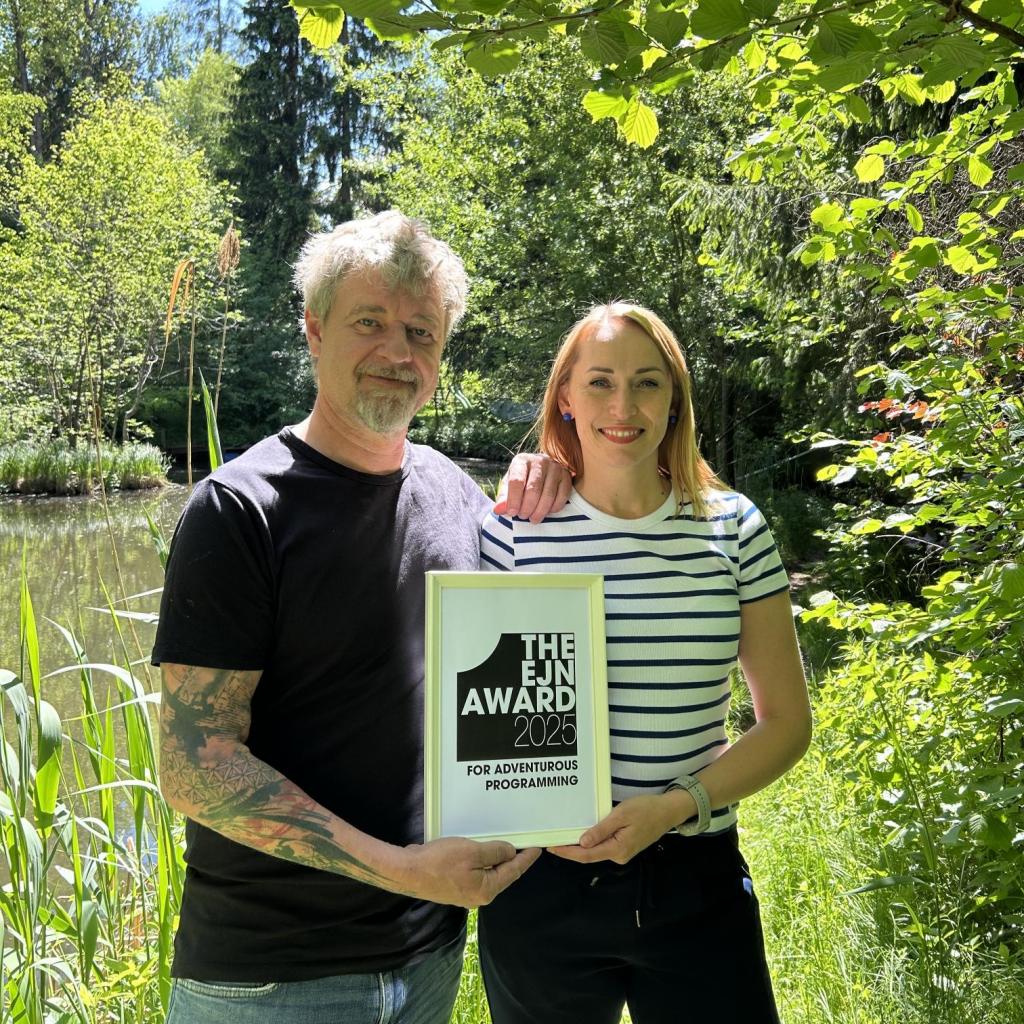
9. Mario Steidl (artistic director) and Daniela Neumayer (production manager) with the EJN award.
EJN Award for Adventurous Programming 2025: The Alpine Laboratory

The Alpine laboratory - adventures in jazz programming
At the 11th Europe Jazz Conference in September, EJN will present JazzFestival Saalfelden with the 2025 EJN Adventurous Programming Award.
High in the Austrian Alps, in a small town of 17.000 people, JazzFestival Saalfelden has gradually evolved from what artistic director Mario Steidl called "a UFO landing" each year, into a more deeply rooted festival with concerts held in mountain huts and rowing boats, as well as the Nexus Club, and a main stage in the town’s Congress Hall.
Winner of the 2025 EJN Award for Adventurous Programming, the festival takes place over four days in late August with around 180 musicians performing 60 concerts across 12-plus stages.
We spoke with Mario about the festival’s approach to programming and what makes Saalfelden unique.
From UFO to community celebration
Founded by Gerhard Eder, Jazzfestival Saalfelden established itself with a strong focus on avant-garde and free jazz. Now in its 45th edition, the festival has built its reputation by bringing experimental music to this Alpine setting. Mario has been artistic director since 2004, inheriting a festival with an international following, but he started to see that there was a disconnect between the festival and the local community:
"I didn't like the idea, you know, that the jazz festival is like a UFO landing in this little village and there is nothing for the locals," he explains, adding that the festival receives public funding and with this comes a responsibility to give back to the community.
The festival created a new free programme layer, designed for people in the local community. A large stage was erected in the town's Stadtpark, programming accessible genres like funk and reggae alongside the more experimental jazz happening in other venues.
Audiences for the park concerts grew from 1.000 attendees in the first year to 4.000 last year, nearly a quarter of the town's population. Mario now finds that people in the supermarket will come and tell him how much they’re looking forward to the festival starting.
Some locals, drawn by the concerts in the park, end up wandering into other free gigs, for example, in the woods, discovering improvised music and challenging their pre-conceptions of jazz: "Often you see young people who are completely astonished and saying, wow, this is jazz. It's with electronics. I didn't expect that. It sparks their curiosity." This curiosity can lead them to buy a ticket to the main stage.
"The good thing now is that the local people say, ‘it's our festival’," Mario says. The festival also supports local businesses through catering, accommodation and food vendors.
Programming at altitude
Programming a jazz festival in the mountains presents challenges very different to our previous adventurous programming award winners in Berlin or Budapest. "Most of the audience and artists come from the bigger cities in Austria, Germany, Italy... from everywhere," Mario explains. International artists are collected from Salzburg or Munich airports, and once in Saalfelden, the town’s relative isolation means the festival must create its own ecosystem.
The ecosystem includes venues that are all within walking distance, from the 1.300-capacity main stage to a 600-year-old farmhouse, with more options offered by the surrounding landscape. Performances float across the lake in rowing boats, hikes lead musicians and audience to gigs in mountain huts, and 600-plus people gather in the woods, “sitting under the trees in front of the stage and listening to the concert”.
The rural Alpine setting also demands a different financial model. When the festival faced financial issues in 2004 and the city government thought” we don't need that jazz stuff," it was the Tourism Board that stepped in, recognising that "it's the only event in the entire year where international visitors, journalists, promoters" come to Saalfelden. This unusual arrangement - Mario doesn’t know of other jazz festivals organised by a tourism board - provides stability while maintaining artistic freedom. And the challenge of attracting audiences to a remote location has become an advantage: visitors arrive early, stay longer, and immerse themselves fully in the festival and the mountains. There’s now an additional three-day mini jazz festival that takes place in ski season, giving a taste of the festival to winter visitors.
JazzFestival Saalfelden's imaginative approach to venues and landscape has moved the festival away from a one-size-fits-all concert hall approach. Each venue is matched to specific musical needs. Mario confirms this: "I was often discovering new musicians, music and projects that needed different surroundings to a big concert hall, music that needs a more intimate setting… I wanted to provide musicians with the opportunity to present their projects in the right setting."
Trust as a creative strategy
For Mario, programming Saalfelden isn't an annual task but a continual process, one driven by discovery. His advice is “just to be curious and to explore new music, to be open…When I listen to an artist and I love it… It makes me so happy when I can book it…You book concerts with your heart, then you're in love with every project." He explains that the programming doesn’t "really have a starting point, because you're always working on the next edition already”. He adds that, ultimately, “I like to present the diversity of jazz and what jazz can be.”
The programme always opens with a commission from Austrian musicians, and is built with attention to flow, pacing and how the audience will experience it. Mario will add a contemplative set after an explosive free improvisation, and ensure that Saturday's 1 am closer is powerful, and will "burn down the house."
One of the recurring themes of our conversation is trust - trust between programmer and artist, and artist and audience. Artists present projects at Saalfelden that haven’t been shared before: “It can be a brand new project that even I have not listened to before.” Mario is prepared to take risks with new commissions and gives artists the freedom to invite collaborators who are already at the festival. For example, this year, Dutch artist Teis Semey was invited to present several gigs, with autonomy over what to present and where.
Mario is prepared for what this means: "You don't have the guarantee that a project that you have never heard before will work out for the audience." For him, this uncertainty mirrors the essence of the music itself. "I think that's the idea of jazz or improvised music, to trust in others, and to do something together that’s not pre-determined, but to give room to each other."
This commitment to discovery is something that’s valued by the festival’s audiences. When the festival surveyed attendees, 98% agreed that ‘I come to Saalfelden because I see and hear things that I've not heard before.’ Mario adds, “They know they will experience projects and artists that aren’t touring the whole of Europe". Mario encourages the debates that the programme sparks: “I really like it when audiences discuss it after the concerts, is it jazz? Is it not jazz? Though I don’t think we have a jazz police!"
The festival has shifted away from booking established names. “We totally agree with presenting big names, but I think it's our responsibility to present the big names of tomorrow," says Mario. This approach has a financial benefit, with more money to go around in fees. “Suddenly, you have lots of money left that you can spend on more stages with younger musicians and more adventure."
Artists are invited to stay for all four days rather than coming for a single performance, and Saalfelden becomes a testing ground. The festival bar becomes what Mario calls "the hang place, the place to be after the last concert on the main stage, because everybody goes there. You meet journalists, you meet promoters, you meet musicians, you meet everybody." This often leads to new collaborations "You often get offers from musicians who say, I really would like to try something, you know, and I think Saalfelden would be the best place for it. It’s because they’ve spent four days here to understand how it works.”
Less becomes more
Environmental thinking also shapes Saalfelden's programming decisions in concrete ways. It has reduced its artist roster from 250 to nearer 180. "We try as much as possible to include musicians in other projects, and move away from these on-off shows, to fly in every person just for one gig and the next day fly back," Mario explains. Most central European artists travel by train, and all festival transport uses electric vehicles. He also coordinates with other festivals to create efficient touring routes.
The emphasis on multiple performances by artists reduces the festival's carbon footprint and also creates the extended residencies that enable Saalfelden's adventurous collaborations.
From competition to collaboration
When asked what advice he'd give to other festival programmers wanting to push into more adventurous territory, Mario is quick to point out that what works in one context may not translate elsewhere, explaining that Saalfelden benefits from a 45-year history and a longstanding audience who trust in the programming. "Sometimes when you're a festival, you're not in this comfortable situation and you have to present these big names or more commercial music to fill the hall."
He enjoys the collaboration with other festivals and acknowledges a shift away from competitive secrecy to collective endeavour, with programmers sharing discoveries and asking each other for advice. "When I started in 2004, people had this habit: I don't tell anybody before I release what I have booked. I want to be the only one… Then younger people turned up and now programmers think it's about the musicians and not about our egos!"
Adventures ahead
This year, the festival (21-24 August 2025) includes UK artist Laura Jurd, who Mario says "will present her new project and play a concert in the woods... and one up on the mountain." He's particularly curious about Saturday's closing act: "Tomoki Sanders, the son of Pharoah Sanders, because as far as I know, he has not been in Europe before." But what excites him most are: "The late night sessions where you don't know what is going to happen, who has come from the main stage and is joining the sessions... It's always an adventure."
JazzSaalfelden has some unique advantages compared to other European jazz festivals. Its Alpine landscapes are as much a draw as the music, and the festival has leaned into this, using nature’s amphitheatres as stages. Its strong backing from the tourism board allows it to experiment and be bold - artists are given creative autonomy and the freedom to experiment with new collaborations. And there’s a loyal audience, eager to join this journey each year.
Commenting on the award, Mario says: "I don't see it as a pinnacle of my contribution to the festival or as a final round of applause," he reflects. "It makes me sure that we are on the right track, that the things that we are doing are honoured by audiences, by promoters, by people who are part of this EJN family.”
Image credits (photos from the 2024 festival)
1. Michael Geißler
2. Rosario Multari
3. Matthias Heschl
4. Matthias Heschl
5. Rosario Multari
6. Rosario Multari
7. Matthias Heschl
8. Matthias Heschl
9. Mario Steidl (artistic director) and Daniela Neumayer (production manager) with the EJN award.