
EJN press release
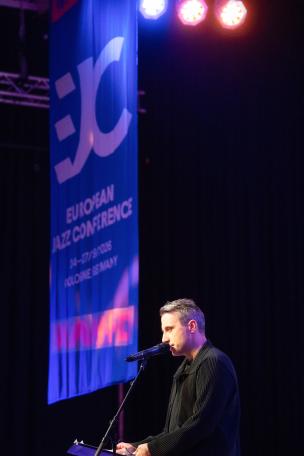
Keynote speech by Alexander Hawkins at the European Jazz Conference 2026
Who We Are, What We Stand For
Full text of the keynote speech by Alexander Hawkins at the European Jazz Conference 2026. Published with the permission of the author.
Recent years have shown worrying gains for authoritarians and nationalists across the globe. In some places they are in power (Trump, Milei, Erdogan, Vučić, Putin), whilst in others, they are ominously close (Weidel, LePen, Farage). By virtue of the threat they pose, they are causing ostensibly more moderate political leaders to lurch towards the extremes. Some refer to a concept known as the ‘Overton window’: that range of policies which a politician may espouse without being regarded as ‘too’ extreme. This window is moving. Daily, we see the normalisation of ideas previously only discussed cautiously, and in select company.
Racism and division can nowadays unproblematically and advantageously be overt. We are no longer not dealing with an old school of politician who at least seeks to conceal his motivations (and let me use the masculine pronoun here, because even though it fails to capture the threat of a Weidl, a Meloni, or a Le Pen, nationalism does seem to be heavily gendered as a general pattern).
Right-wing authoritarians are weaponising culture: leaders seek to caricature culture as the preserve of educated elites - and of course, mass education is one of the right’s greatest fears. Ignore these politicians’ own vast wealth and ties to big business: why should the ‘woke’ few enjoy culture, when we can reallocate the resources it consumes instead to white elephants like ‘keeping borders secure’, the prison-industrial complex, or any number of private-sector ventures?
The arts can also trouble authoritarians for their capacity to galvanize and give voice to minorities. Look, for instance, at how Franco targeted Catalan and Basque self-expression; look at how the Conservative government in the UK targeted rave culture in the early 1990s; and look at the complex battleground hip-hop has often been throughout its existence. Furthermore, the arts are like birds: they have an inconvenient habit of ignoring borders. Add this nationalist headache to the mix: arts from different backgrounds love to mix and play together.
All of us in this room will probably be experiencing the effects of this political climate in subtly different ways: but some of the common themes are likely to be dramatic cuts in funding (if we’re an organisation fortunate enough to receive funding in the first place), and perhaps also in staffing (if we’re an organisation fortunate enough to have staff: and it’s important to say the volunteer ecology of our music is almost certainly sadly still under acknowledged and under-discussed). Problems with audience attendance may well also often be related to financial hardship. In short, for many - even most - here, it’s probably getting harder to keep the lights on, literally and figuratively.
Perhaps, then, some of this is what we want to take a stand against, both for reasons of (completely justified) moral indignation, and for more basic instrumental reasons of self-preservation. So let’s consider our audience. In our most frank analysis, if we are to take a stand, who is going to notice?
In this room, we will have many differing viewpoints; but let’s assume that there may be some broad issues on which we can reach a consensus. Within Cologne, on this weekend, we might even be able to make our voices heard loud and clear. But how about within the jazz community in Europe more broadly? How confidently can we imagine those within our musical sphere who are either not here this weekend, or who prefer not to align with organisations, accurately articulating what ‘we’ decide ‘we’ stand for? Do they, and should they, even care? Let’s broaden it out. Beyond the arts, do we really think there are significant audiences - public or political - which have any detailed idea whatsoever of the political stances of this, or indeed any other, cultural organisation?
Let me change tack for a moment, and introduce a new idea. For any job, it’s helpful to find the right tool. Sometimes, for example, it can be useful to think of music as language. So: we can meaningfully say that music ‘speaks to us’, or that it’s ‘lyrical’. Music as language is also absolutely central to understanding traditions such as the Yoruba talking drum. I could go on. However, if I want to ask for a coffee, music is for sure a very clumsy way to do so. Or, to put it another way, music is not that sort of language. So the potentially uncomfortable question should now be occurring to all of us: is the EJN really a useful tool for standing up to political trends, and trying to bring about change? And much as the answer is awkward, and might be dispiriting, I would argue very strongly that no, it is a very blunt, inefficient tool for bringing about the desired result - at least, at first glance. We risk either preaching to the choir, or trying to address people who can’t hear us, and who probably don’t care in any case. Coming up with a policy statement wouldn’t necessarily hurt, but I think we would be naïve to think it would cause anything other than the tiniest ripples at best, even if it might massage our consciences temporarily.
Sure, we can maybe get organized to lobby for improved funding, although as we know, this is easier said than done. But things such as poor funding are best understood as symptoms, rather than the problem itself. Better funding is a short term fix. If I have a wasp sting from a nest in my house, I will want to treat it to relieve the pain, even if more fundamentally what I really need to do is either remove the nest from my house, or, unlikely as it may sound, move my house away from the vicinity of the wasp’s nest. But if I’m honest, better resourcing for the arts as such isn’t really what I want to stand for. What I mean by that is this: if we could create a social context in which all our concerts and related activities paid for themselves without external injections of cash, this would be great, and there would be nothing morally problematic about the fact that funding wasn’t involved. Arts funding isn’t intrinsically good in the same way in which authoritarianism, nationalism and racism are intrinsically bad.
So how can we move against the prevailing geopolitical climate? If we adopt the skepticism of my analysis, what then is the place of a cultural organisation in the struggle? To address this, I want first to turn to look at the ‘we’ in the conference title: who we are, what we stand for.
As an artist, there are many contexts in which I’m suspicious of the ‘we’. ‘We’ can suggest assumption, generalisation, and categorisation. If somebody talked to me about ‘bandleaders like us’ or ‘pianists like me’, my immediate reaction would likely be a certain sort of defensiveness. I would be anxious, for example, about the possibility that I wasn’t working hard enough to be completely personal in my music, or equally, that they simply weren’t working hard enough to hear its distinguishing features. Furthermore, ‘we’ almost always implies a ‘they’. A club, for example, implies people outside the club: and this is one of the critical tools we should use, for example, to scrutinize organizations such as the European Union, or indeed, even the EJN itself. To put it another way, ‘we’ can be empowering and inclusive, but it can also be ‘othering’.
When this conference tries to identify a ‘we’, it will be a complex thing. There is a foundational paper in legal theory called ‘Transcendental Nonsense and the Functional Approach’ by Felix Cohen - a piece which was very important in the birth of legal realism, which was one of the main intellectual precursors to the critical studies movements which are so important today, as well as so despised by the political right. In this piece, Cohen essentially suggests that entities such as a ‘corporation’ - and he would happily include a ‘Jazz Network’ within this, I’ve no doubt - form part of an unhelpful ‘heaven of legal concepts’: if we truly want to understand such entities, he argues, we need instead to look at their constituent members. And we, here, as I have said, will have many differing outlooks, some compatible, some less so.
But the complexity of ‘we’ is also key to understanding that by acknowledging our potential impotence as an organisation is not somehow to abdicate political responsibility, and that we needn’t feel helpless having adopted a certain realism about our place. Mingus intriguingly titled one composition ‘Myself When I Am Real’. But who, for example, am I? I am a musician, and within that, a pianist, a composer, a bandleader, and so on. I am also a teacher. I am also a sucker for Italian food, and a completist of both Eduardo Galeano and Charles M. Schulz. I am someone who is slowly trying to teach himself some Japanese; I’m an uncle; and, for my sins, a fan of Chelsea football club. And I could continue.
By understanding that as humans we wear multiple hats, we come to understand that we do not necessarily have to make our stand in our particular rôle as members of this community. It is absolutely OK for our activities to be confidently and unashamedly about the art, so long as we do not abdicate responsibility in the sphere of our life where we feel we can be most effective in fighting the system. Let’s be realistic: surely a much, much more effective front line for the fight is through organisation in the classroom, since education is key to understanding, tolerance, and compassion. A much, much more effective front line for the fight is through the unions, since the unions have the ability, for example, to disrupt wealth production. A much, much more effective front line is on the streets, since civil disobedience is an unequivocal warning to power. A much, much more effective front line is through product boycotts and similar; and - in general - a much more effective front line is at the ballot box, if we are lucky enough to have access to it. I am not naively putting my faith in any one of these mechanisms, but for sure in combination, they have promise.
Simply because we are passionate and concerned about geopolitics, and because we are passionate and concerned about music, it does not follow that we must attempt to open a geopolitical front by linking the two. The global situation is so urgent that we have to be ruthlessly targeted with our (necessarily limited) energies.
And yet intuitively we might still feel that what we do has political relevance. Correctly so, in my opinion: and I’m glad, because for all I’ve argued above that ‘we’ is a tricky concept, and even a dangerous one in some versions, of course I am a committed believer in incarnations of the ‘we’ such as solidarity, collective action and community.
What we need to do is to adjust our focus. The sleight of hand of the authoritarian with his cult of personality is to make himself the centre of attention; to lure us into the trap of a top-down conception of politics. The misdirection also means that we risk naively focussing on ‘the politician’, when, as we know, power is also brokered by plutocrats and technocrats such as the Elon Musks and Peter Thiels of the world, as well as various organs of the media.
Well, as I’ve argued, we’re probably delusional to imagine the ‘top of the tree’ as a useful target for our attentions. To put it another way, we’re wasting our time trying to tell these people what we stand for: they most likely won’t even hear our message, and even if they do, almost certainly won’t care. Even at the best of times, politicians aren’t exactly known for having ‘eureka moments’ in response to principled arguments. Taking a stand against the top of the tree might even trick us into feeling better about things in the short term, but will be not unlike rearranging the deck chairs on the Titanic. Instead, we should take notice of what happens when we concentrate on political action as a process of building from the ground upwards. What happens when we show our own communities what we stand for? And how can we do this?
For a start, what we can do is to model a certain way of being. In all our actions: programming, logistical, in how we communicate with each other, we can model an instance of a coherent, fair community. We can model equality of opportunity. We can model fairness in questions of access. We can model innovation. We can model daring. We can model environmental best practice. We can model financial even-handedness. We can model independent, critical thought, personal responsibility, and a healthy skepticism of the machineries of engineered ‘taste-making’. We can, through our activities, create spaces for freedom of expression, and at the same time spaces where we - as musicians no less than as presenters, writers and so on - can learn or re-learn what freedom of expression actually is, removed from fashion, cliché, and market powers.
Our ecosystem can model that people from vastly different backgrounds - cultural, linguistic, geographical, and so on - can come together and create beauty. We can model the antithesis of the classic right-wing caricature of more communitarian conceptions: we can show - just as Duke Ellington was already doing in his ensembles more than 100 years ago - that radical individualism can exist in complete harmony within radical community. Where nationalism seeks to ‘other’, we can show difference as cause for celebration, and a catalyst for discovery. And we must also model constructive and radical self-criticism, because lip-service and public pronouncement can trick us into thinking we’ve done something useful, when in reality, it is not even close to enough: action is the thing. (I would also urge the same levels of self-criticism to my fellow musicians: I’m sure all of us in this room can think of examples where a lazy veneer of quasi-edgy or radical rhetoric has been applied to something essentially very conservative).
The crucial thing is that these values which we can nurture will seep through into, and galvanize, our attitudes in other areas of life, as well as the attitudes of our community more broadly understood. And it is perhaps in these areas of life in which we can more meaningfully take on geopolitical trends in a direct sense. What I am saying, therefore, is this: arts organisations might be relatively impotent and inefficient for taking the fight direct to politicians. But perhaps counterintuitively, by turning the gaze more inward, and creating the best conditions possible for the art itself, we can then begin to be more relevant to the world at large. And this has interesting parallels with how protest music itself largely operates: by galvanizing, educating, and provoking its audience. Let’s be real: who in general is listening to Marvin Gaye’s What’s Goin’ On - the people in Silicon Valley, Wall Street, Frankfurt and so on? Or a demographic looking a little more like the one in the room today?
If the tide of authoritarianism can be stemmed, we will not only be appeasing our most obvious symptoms - for example, through funding coming back online - but we will also be addressing some causes of other aspects of our discomfort. Healthier education systems will fundamentally shift understanding and interest across the arts, and a more just society should provide potential concert goers with more disposable income (if a lack of this is indeed a contributing factor to attendance issues) - though I fully understand that this latter point is far, far down the road.
Throughout this talk, there have been several directions which I haven’t taken for reasons of time, but which the academic in me is very uncomfortable not addressing. For example, it is an omission not to address questions of AI and what taking a stand against this might look like - even though the issues certainly intersect with issues of plutocracy and so on. I have avoided the questions so as to avoid a superficial treatment of a complex set of issues in the short time available. I have also - and this is partially perhaps in the nature of speeches as opposed to various forms of the written word - made statements which certainly would require proof and nuance in a lengthier treatment.
I am also very uneasy with assumptions about the centrality of funding. I talked earlier about the possibility of moving my house away from the wasp’s nest, rather than vice-versa, and this is an example of the type of thinking I was signposting: can we please at some point discuss how we might think about recasting ourselves outside the economic frame? What models, for instance, can we find from within our music for self-determination, outside the orthodox modes of production? Community organisations such as the AACM, UGMAA, and the Black Artists’ Group have been documented in considerable depth at this point, and I don’t think we engage enough with questions not only of how we might be able to subsist outside economic norms and structures, but of what we actively might stand to gain creatively from doing so. Let’s remember that not engaging with these orthodox models is another way to dilute existing power structures.
I would also suggest that we should avoid some kind of what we might call ‘hero’ syndrome in the arts. We should very seriously consider whether we can make a virtue out of some kind of macro level political insignificance. Geopolitics is draining. It can impoverish; it can be frightening; it can be exhausting. It is not a weakness to acknowledge any of these things. Is one of our great virtues that the arts can provide a refuge, even temporary, from this? I’ve long been inspired by a wonderful quote from the great St Lucian poet Derek Walcott, who speaks of having ‘no nation now but the imagination’; and in fact, I was introduced to Walcott’s work by my friend, the inspirational Iranian-American writer Azar Nafisi, who titled her brilliant defense of the relevance of literature ‘The Republic of Imagination’. Surely one of the virtues of what we do is that we can create oases - sanctuaries both from the day-to-day grind of making a living, and from macro-political issues. And to create these spaces for beauty and reflection, this in itself is part of the struggle. It’s instructive to consider artists such as Sun Ra here. Think of all of the tropes of escapism in his work: Space is the Place, Rocket Number Nine Takes Off For The Planet Venus, There Are Other Worlds They Have Not Told You Of, and so on…this is world-building as a means of empowerment. Think too of World Builders such as Anthony Braxton, or Cixin Liu (the author of The Three Body-Problem). We shouldn’t underestimate relative invisibility and outsider status as a way to enhance our ability to provide respite. Because when we do come back to the real world after the musical experience, we will hopefully be reinvigorated, with an enhanced capacity to face down the political challenges about which we need to be so concerned.
Making space for people and beauty, whatever the external forces; modeling a just and equitable ecosystem within our domain; understanding that rest and play are not some bourgeois luxuries but instead universal entitlements which need to be safeguarded: all of these ideas illustrate that making the music happen is perhaps the crucial political act to which we, here, can best turn our attention. Maybe this is how we can take our stand.
Alexander Hawkins, Oxford, July/September 2026
Photo by (c) Janet Sinica