
About EJN
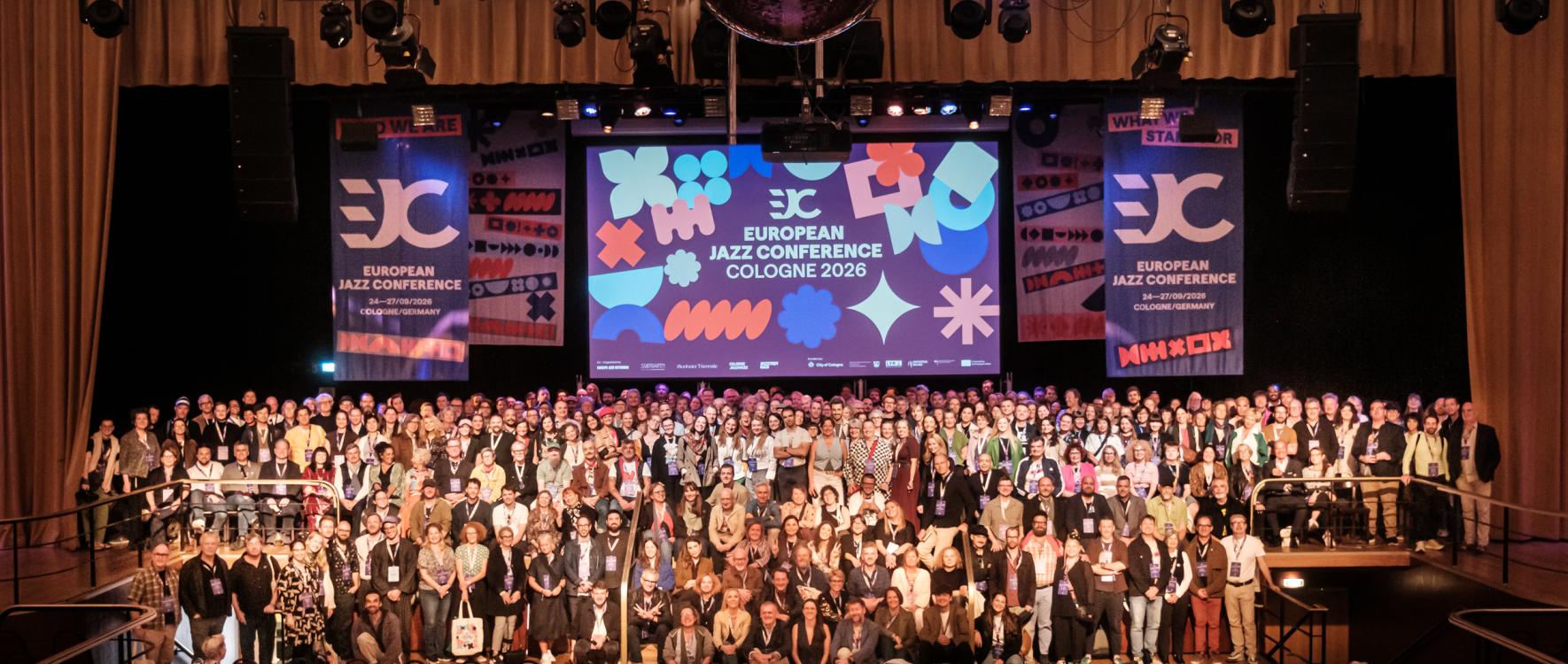
The Europe Jazz Network (EJN) is a nonprofit Europe-wide association of organisers who specialise in creative music, contemporary jazz and improvised music created from a distinctly European perspective.
The membership in September 2026 includes 214 organisations (festivals, clubs and concert venues, national / regional support organisations, honorary members) from 39 countries.
EJN exists to support the identity and diversity of jazz, creative and improvised music in Europe and broaden awareness of these vital areas of music as cultural and educational forces.
EJN's mission is to encourage, promote and support the development of the creative music sector in Europe and to create opportunities for artists, organisers and audiences from the different countries to meet and communicate.
EJN believes that creative music contributes to social and emotional growth and economic prosperity. It is an invaluable channel for the process of inter-cultural dialogue, communication and collaboration. Music is a positive force for harmony and understanding between people from the diversity of cultures inherent in the European family.
EJN's work includes the organisation of an annual European Jazz Conference and other networking and exchange meetings between its members. It also includes training and capacity building activities, pilot projects and research, advocacy actions across Europe, provision of information and communication – through various traditional and new media and the EJN web portal.
EJN and its work is managed by an unpaid Board of Directors elected by the membership, by members' working groups and by a paid management team.
BYLAWS of Europe Jazz Network (pdf format, updated 16/09/2021)
INTERNAL REGULATIONS of Europe Jazz Network (pdf format, updated 12/09/2024)
In recent decades, contemporary jazz and improvised music in Europe have experienced breathtaking developments.
The diverse European expressions of jazz, whilst inspired by respect for the American pioneers, have found ideal conditions to develop in Europe and have resounded with their own cultural identities.
The main characteristic of jazz, its ability to integrate an array of human emotions through spontaneous composition and ever-flexible musical structures, has broken through barriers of language, race and class.
European jazz already functions as a catalyst between different cultural heritages from local and migrant sources and between known and newly-discovered musical forms.
Its openness and thirst for diversity is a permanent self-protection against any kind of nationalism.
As an artform, jazz has always produced its best artistic results at the meeting point of cultures and social structures in transition.
Taking its full place among the other arts, jazz is able to reflect the development of a constantly evolving Europe at the beginning of the 21st century which is characterised by a diversity of regions, languages and cultural heritages and to stimulate preparedness for mobility and flexibility.
Improvisation in music, as a non-verbal artform, allows creators of different origins to communicate immediately and to create exciting musical experiences for audiences of all generations.
It demonstrates the ability to bring identities together in collaboration rather than in conflict. An essential balance between self-expression and collective responsibility also makes jazz an ideal medium for cultural education.
Jazz affirms its place alongside the other arts and offers a unique contribution to the future health of European society.
Written by Reiner Michalke & Nod Knowles.
Adopted at the EJN General Assembly and Colloquium, Budapest, October 2004
The Europe Jazz Network (EJN) is one of the oldest and largest cultural networks in Europe, with over 200 member organisations spread in 38 different countries. The core mission of the organisation is to bring people together, discuss, share experiences and learn from each other. EJN’s key activities include international conferences, seminars, meetings, exchange programmes and pilot schemes where professionals from different countries, cultures, ages, gender identities and backgrounds meet and interact.
Please download the pdf version of the EJN Code of Conduct at this link.
Values
EJN is committed to providing a safe, relaxed and friendly environment for all the individuals involved in the activities and in the life of the network. EJN asks its members, and all the participants of its events, to be respectful of each other, aware of the cultural differences that are present in such an international context and to be supportive of and kind to each other in order to maintain this atmosphere which is at the core of the network’s values. If any individual witnesses behaviour they deem to contravene the standards set out in this Code of Conduct, even if they are not the direct victim of it, they are encouraged to raise it via the process outlined in the protocol below. A truly safe environment can be achieved only when everybody is actively contributing to it. The following Code of Conduct is based on the underlying philosophy that EJN respects every individual’s right to dignity, privacy, integrity and safety as well as their right to an equal and fair treatment in their professional environment.
Scope
This policy applies to all the individuals participating in activities directly organised by EJN, or in collaboration with members and partners, both in presence and online, including phone communication and digital exchanges, and is enforced where EJN’s activities are implemented or discussed, including conferences, seminars, meetings, social events and EJN’s communication channels.
Unacceptable behaviours
Examples of unacceptable behaviours covered by this policy include:
- Discriminatory behaviours or remarks, based on age, gender, race, religion, sexual orientation, political beliefs, citizenship, marital status, family status, disability or any other possible ground;
- Sexual harassment, in any form, including, but not limited to, unwelcome sexual advances, requests for sexual favours, unwanted physical contact, assault, inquiries or comments about an individual’s sex life;
- Physical and verbal violence, in all its forms;
- Insulting, intimidating or otherwise offensive behaviours, including, but not limited to, bullying and cyberbullying, inappropriate or unwelcome focus or comments on a person’s physical characteristics or appearance, isolation and shunning, gossiping, spreading of rumours and name-calling;
Generally, every individual should abstain from any action that another person perceives as inappropriate, or that creates uncomfortable personal feelings.
Reporting protocol and disciplinary actions
EJN is committed to an efficient and safe process for reporting infractions, including:
- The right of individuals to report incidents, either that they experienced directly or that they witnessed, without fear of negative consequences or retribution, including protection from retaliatory actions;
- The timely reporting of all incidents, without a set statute of limitations. In the case of violence, individuals should call police and/or emergency services immediately;
- The right of a victim to confront their harasser (where comfortable) without the fear of retribution, and of the victim to challenge the harasser on their behaviour (where comfortable) at the time of the incident or at a later stage, with or without the presence of a mediator (the confidentiality contact);
- A clear line of reporting incidents to a designated official (the confidentiality contact), who is made known to all network members and to other participants in EJN events. The confidentiality contact can be an internal person from the network or an external professional, will guarantee discretion to the process, and act as a mediator between the parties, if required;
- An Advisory Committee on Code of Conduct violations is established in order to assist the Board in taking decisions about disciplinary measures related to possible Code of Conduct violations. The Advisory Committee is composed of three people: one external confidentiality contact, one EJN honorary member and one active EJN member, and is appointed each year by the General Assembly of members;
- If the victim allows it, the confidentiality contact may report an incident to EJN Staff, who will then involve the Advisory Committee and convene the EJN Board of Directors in the shortest time possible;
- Possible disciplinary measures will be discussed by the Advisory Committee and presented to the EJN Board of Directors for a final decision. Should the cases involve a member of the Board, Advisory Committee, Staff, or if any other conflict of interest is present, those individual(s) involved will not be part of this discussion or decision;
- Depending on the gravity of the incidents, or on their repetitive nature, disciplinary actions towards an individual may include:
- Formal warnings by the EJN Board (minimum level);
- Temporary exclusion from an event and prevention from using the event’s communication channels (medium level);
- Permanent expulsion from all EJN events and communication channels (maximum level).
- If the individual is a representative of a EJN member organisation, and depending on the gravity of the incident, the EJN Board may also ask the member organisation to change the EJN representative from this organisation, or, if this is not possible, to temporary exclude the organisation from the membership, until the General Assembly is asked to vote on its exclusion, according to the EJN bylaws (article 7.4- Termination of Membership).
EJN was formed in 1987, at a time when the internet and emails were in their infancy. From the inspiration that new electronic communication methods could make it possible for promoters to share ideas and collaborate in organising tours and concerts, EJN was created as a network of promoters who connected with one another through the newly emerging medium of the world wide web.
1987
Based in Italy, and prompted by the vision of Filippo Bianchi, in the succeeding years EJN recruited almost 20 members, who collected and shared information on musicians and live music promotion. As technology developed it was able to make this information more widely available through its website. In the late 1990's, EJN accessed Kaleidoscope grants from the EU for this farsighted network project.
1990
In 2001 EJN transferred its legally registered office to Pantin (just outside of of Paris) France, at the venue of one of its members, La Dynamo of Banlieues Bleues
2001
In 2002, 11 members of EJN joined together in a major artistic collaboration - Europe Jazz Odyssey (EJO). Funded through a Culture 2000 grant from the European Commission, EJO enabled the partners to mount a three-year programme of innovative collaborations, residencies and workshops between musicians from across the continent, and a series of colloquiums which explored the status of this key area of musical action.
2002
Following its 2004 General Assembly in Budapest, EJN merged with TECMO (Trans European Creative Music Organisers), a like-minded network of jazz promoters, unifying under a single European platform. At the same time, EJN members formally adopted the organisation’s manifesto, defining its shared principles and commitment to artistic exchange, international cooperation, and engagement with European cultural policy.
2004
EJN’s annual General Assemblies during this period were held in Istanbul (2005), Helsinki (2006), and Bruges/Ghent (2007). These meetings became vital opportunities for members to exchange ideas, discuss strategy, and explore the jazz scene in different host countries. They also welcomed non-members and professionals from the broader cultural sector, helping to broaden EJN’s visibility and impact across Europe.
2005-2007
With support from the European Commission, EJN secured operational funding that allowed the hiring of its first part-time staff: a Project Manager and an Information Coordinator. That same year saw the launch of a redesigned website and the start of a strategic plan aimed at growing the network’s membership, boosting advocacy for jazz in Europe, and initiating research into the scope and impact of EJN member activities.
2008
in 2014, EJN received for the first time a project grant from the European Commission under the new Creative Europe programme, culture strand, as one of 28 European cultural networks. The second grant of this kind was awarded to EJN in 2017 and ran until 2021.
2014 - 2021
The new Creative Europe support for networks started at the beginning of 2022, when EJN was awarded for its project: EJN: Shaping the Future of Creative Music (ESC), that ended successfully in 2024. In 2025 began the new ESC-2 project, the continuation of the previous 3 years of activity, thanks to the Creative Europe support for cultural networks. This project will run until the beginning of 2029.
2022 - 2029
In 2025, EJN partnered with 10 other organisations across Europe for a new Horizon Europe-funded project: AMPLIFY, that aims to research new ways to create, connect and inspire through innovative technological solutions, merging physical and digital music experiences.
2025
BOARD OF DIRECTORS
- Karolina Juzwa - President (Intl Jazz Platform/Wytwórnia Foundation, Poland)
- Steve Mead - Vice-President (Manchester Jazz Festival, UK)
- Rosa Galbany - Secretary (Taller de Músics / Jazz I AM, Spain)
- Mark van Schaick - Treasurer (Buma Cultuur / inJazz, the Netherlands)
- Raluca Baicu (BIRD, the Netherlands)
- Tina Lešničar (Cankarjev dom / Ljubljana Jazz Festival, Slovenia)
- Max von Pretz (Südtirol Jazzfestival Alto Adige, Italy)
- Maria Rylander (Göteborg Artist Center, Sweden)
- Annamaija Saarela (G Livelab Tampere, Finland)
MANAGEMENT
- Giambattista Tofoni - General Manager
- Francesca Cerretani - Event & Office Manager
- Stefano Zucchiatti - Communication & Content Manager
